


Why a strong track record is only the beginning of good underwriting
Imagine it’s the 1970s, and you’re responsible for buying a new computer system for your company. Do you play it safe with IBM, the undisputed market leader, or take a chance on a smaller competitor offering potentially better technology at a lower price?
Now imagine something goes wrong. If you’d chosen the smaller company, your judgment is questioned, perhaps even your job. But if you’d chosen IBM? Well, you went with the most trusted name in the industry. Who could blame you?
More than six decades of reliability had made IBM the safest choice in corporate America, and inspired a saying that defined an era: “Nobody ever got fired for buying IBM.”
Today, the IBM principle is alive and well, and we’ve all lived it in one way or another. We’ve all found ourselves choosing the safer, more established option, even when another looked just as promising. There is always a comfort in making a choice nobody can question.
Investing is no different. Established track records reassure, marquee investors lend credibility, and a name everyone trusts makes a decision that is much easier to defend. It almost feels obvious.
There’s no better example than the one that just happened. Jio Platforms, India’s largest-ever IPO at ₹30,213 crore, was subscribed more than 22 times and closed its first day nearly 27% above its issue price. A familiar name, marquee backing, overwhelming demand: the IBM principle at work.
And we’ve seen this before. Plenty of household names have drawn the same rush of excitement, and their stories have unfolded very differently since.The instinct to trust a familiar name extends well beyond IPOs. And nowhere is it more consequential than in private markets.
Still, public markets at least deliver a verdict every day. In private markets, where capital is locked up for years and there’s no daily price to check against, familiarity carries even more weight. Follow the money, and the pattern is hard to miss.
According to McKinsey-IVCA research, India’s six largest private equity managers accounted for 64% of fundraising between 2022 and 2024, up from 59% during 2016–18.
Now, there’s good reason why established managers attract capital. They bring experience, institutional processes and track records that investors can evaluate. But the concentration raises an obvious question: are investors backing the managers most likely to deliver the best returns, or the ones whose reputation makes them the easiest to back?
And if you are a seasoned investor, this won’t surprise you. Everyone knows past performance doesn’t guarantee future returns. It’s investing 101.
Perhaps reputation offers something beyond confidence in performance: cover if things go wrong. Backing an established manager who underperforms is a bad outcome. Backing an unknown manager who underperforms is a bad decision. Nobody ever got fired for buying IBM.
But how reliable is that track record in the first place?
For years, the rule of thumb in private equity has been to back managers with top-quartile track records and steer clear of first-time funds. Early academic research, including work by Chicago Booth’s Steven Kaplan, supported this thinking. But when Kaplan revisited the question with Robert Harris, Tim Jenkinson and Ruediger Stucke, using data from more than 2,200 US funds, the findings told a different story.
Their 2023 study, Has Persistence Persisted in Private Equity?, found that while past performance remained predictive in venture capital, the relationship had largely disappeared in buyout funds raised after 2000. In hindsight, top-quartile buyout managers repeated their performance about 33% of the time. But based on the information investors actually had when committing capital, that fell to just 24%, roughly what you’d expect by pure chance.
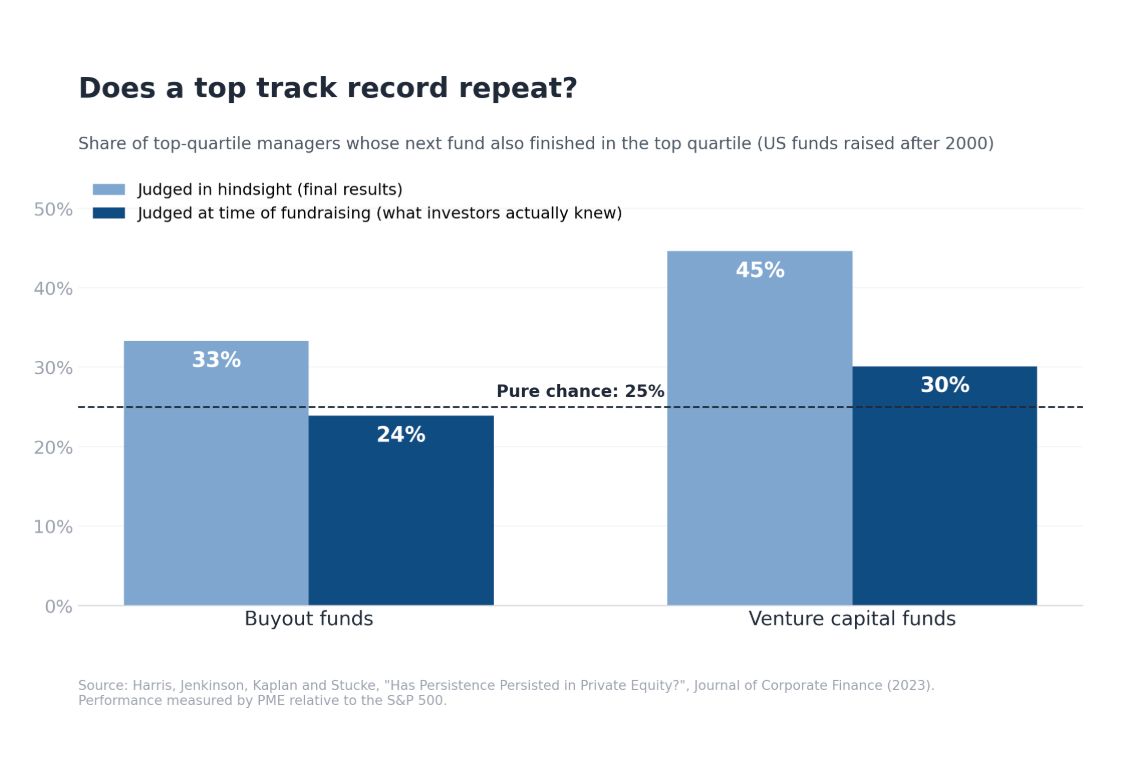
Why the difference? Managers often raise their next fund when the current one’s numbers look strongest, long before the final returns are known. In fact, only 57% of buyout funds showing top-quartile performance at fundraising ultimately finished in the top quartile. And first-time buyout funds performed at least as well as funds run by managers with top-quartile records. The findings underscore the importance of examining what a manager’s reputation is actually built on.
These are US findings, and India’s market has its own dynamics. But our own benchmarking reinforces just how much manager selection matters. In No Ifs About AIFs, our annual report with Crisil, the fiscal 2021 vintage showed striking dispersion: top-quartile funds returned at least 25% annually, the median fund around 17%, and bottom-quartile funds under 2%. As of March 2025, the top half of funds generated 13.6% alpha over public markets, nearly three times the benchmark’s 4.9%.
Manager selection is more of a decision than detail. And it deserves better evidence than a familiar name.
The good news is that India’s private market investors increasingly have that evidence, and they’re starting to use it.
A decade ago, most Indian funds were too young to judge on anything but promise. Today, more vintages have matured and more managers have been tested across cycles. Between 2021 and 2025, PE and VC investment in India reached roughly $207 billion, and exits more than doubled to about $120 billion.
Investors have become more optimistic and more demanding at the same time. In a McKinsey-IVCA survey of more than 50 global LPs, more than half planned to increase their India allocations. Yet they rated Indian managers just 5.4 out of 10 on performance record and 4.9 on exit record, the two criteria they ranked most important.
We see this shift in our own conversations. At Oister, working across fund investments and secondaries has reinforced our belief that a strong track record is only one part of the investment case. The more interesting questions are what produced those returns, where a manager has a genuine competitive advantage, what gives them the right to win and whether that edge can translate into future alpha. An established name may have compelling answers, but reputation alone isn’t enough to pass the test.
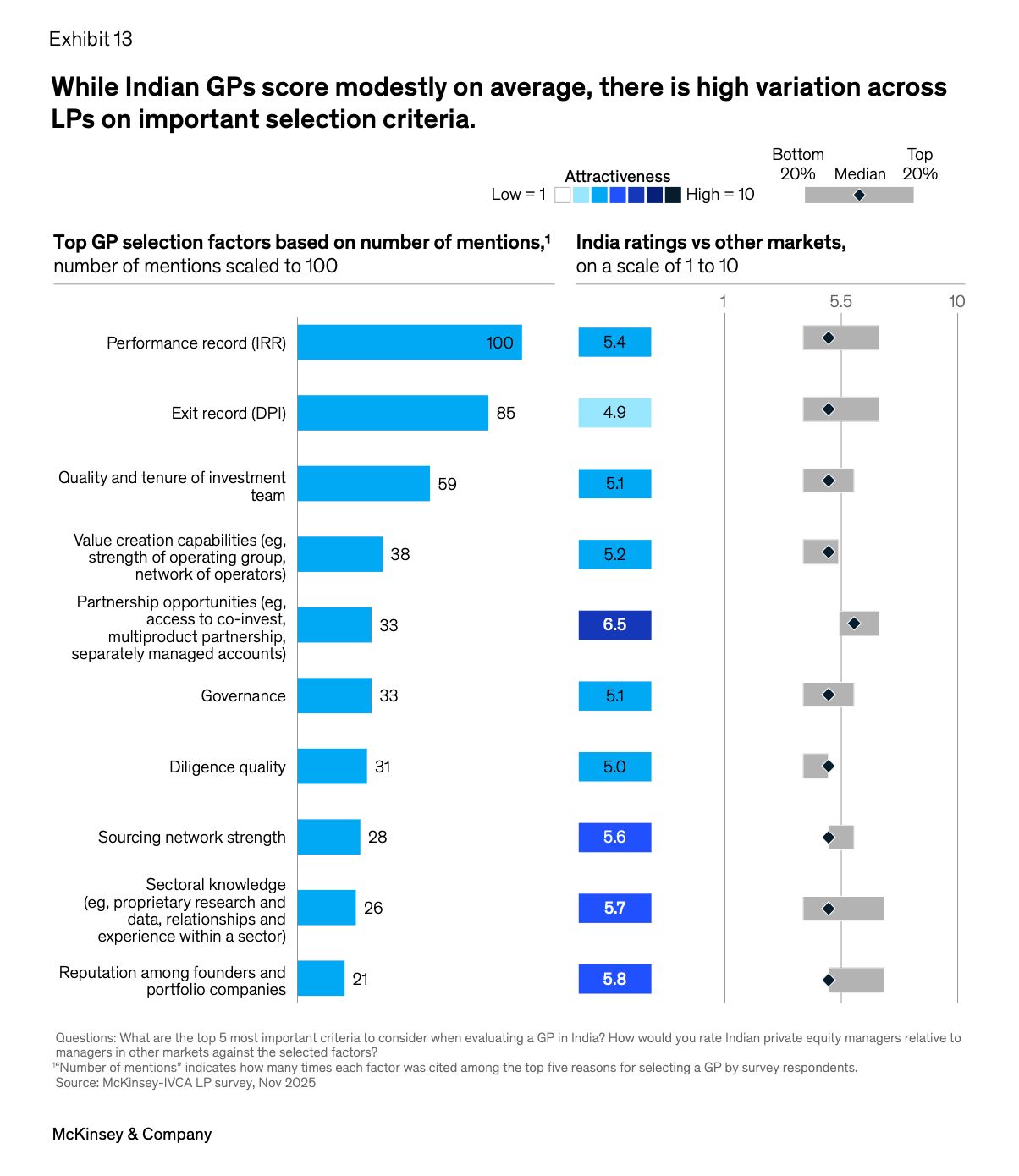
DPI has moved from a footnote to the first slide. Globally, LPs now rank it second only to IRR, alongside multiple of invested capital. In our own benchmarking, only about a quarter of Indian schemes had returned all of their investors’ capital, and those that did took more than seven years. So exits now enter the conversation much earlier, and India’s growing secondary market offers more ways to think about liquidity before a fund reaches the end of its life.
A strong IRR no longer ends the conversation. Investors want to know what produced it: skill, a favourable vintage, a rising market or a handful of outliers. Fund size is part of the same question. A strategy that worked with ₹500 crore may look very different at ₹5,000 crore, and investors want to know whether the strategy has scaled as convincingly as the fund.
Investors want a clearer view of what happens between committing capital and getting it back: valuations, fees, portfolio progress and the assumptions behind reported performance. Globally, the bar is rising; ILPA’s updated reporting template, introduced for 2026, more than doubles the expense categories managers are expected to disclose. And much of this demand is coming from home, with domestic investors now holding more than half of the capital in India’s Category I and II AIFs.
Taken together, these questions reflect a more rigorous assessment of the substance behind a manager’s reputation.
Nearly ninety years ago, John Maynard Keynes observed that “worldly wisdom teaches that it is better for reputation to fail conventionally than to succeed unconventionally.”
It’s the IBM principle in a single sentence. A defensible decision asks whether you can explain it if things go wrong. A good one asks whether the evidence supports it in the first place. Reputation should be the beginning of diligence, not the end of it.
The IBM story has an epilogue that rarely gets told. As computing shifted from mainframes to personal computers, the safest choice of all found itself on the wrong side of that shift. In 1993, IBM posted a quarterly loss of about $8 billion, one of the largest in American corporate history at the time. The reputation was real, but it didn’t describe the future.
And that’s the risk with any familiar name. A reputation tells you what went right before. It cannot tell you whether the conditions that produced it still hold.
Thank you for reading, and see you next month! Wishing all our fellow private market enthusiasts a very Happy Diwali!
Jai Hind


TERMS OF USE
Thank you for your interest in our Website at https://unlistedintel.com/. Your use of this Website, including the content, materials and information available on or through this Website (together, the “Materials”), is governed by these Terms of Use (these “Terms”). By using this Website, you acknowledge that you have read and agree to these Terms.
NO OFFER, SOLICITATION OR ADVICE
Our site is provided for informational purposes only. It does not constitute to constitute (i) an offer, or solicitation of an offer, to
purchase or sell any security, other assets, or service, (ii) investment, legal, business, or tax advice, or an offer to provide such advice or (iii) a basis for making any investment decision.
The Materials are provided for informational purposes and have been prepared by Oister Global for informational purposes to acquaint existing and prospective underlying funds, entrepreneurs, and other company founders with Oister Global's recent and historical investment activities.
Please note that any investments or portfolio companies referenced in the Materials are illustrative and do not reflect the performance of any Oister Global fund as a whole. There is no obligation for Oister Global to update or alter any forward-looking statements, whether as a result of new information, future events, or otherwise.
PURPOSE LIMITATION AND ACCESS TO YOUR PERSONAL DATA:
We will only collect your personal data in a fair, lawful, and transparent manner. We will keep your personal data accurate and up to date. We will process your personal data in line with your legal rights. We use your name and contact details, such as email, postal address, and contact number to continue communications with you. We may also use your contact information to invite you to events we are hosting or to keep you updated with our news.
USE OF COOKIES OR SIMILAR DEVICES
We use cookies on our website. This helps us to provide you with a better experience when you browse our website and also allows us to make improvements to our site. You may be able to change the preferences on your browser or device to prevent or limit your device’s acceptance of cookies, but this may prevent you from taking advantage of some of our features.
MATERIAL
The material displayed on our site is provided “as is”, without any guarantees, conditions, or warranties as to its accuracy, completeness, or reliability. You should be aware that a significant portion of the Materials includes or consists of information that has been provided by third parties and has not been validated or verified by us. In connection with our investment activities, we often become subject to a variety of confidentiality obligations to funds, investors, portfolio companies, and other third parties. Any statements we make may be affected by those confidentiality obligations, with the result that we may be prohibited from making full disclosures.
MISCELLANEOUS
This Website is operated and controlled by Oister Global in India. We may change the content on our site at any time. If the need arises, we may suspend access to our site, or close it indefinitely. We are under no obligation to update any material on our site.
CONTACT INFORMATION
Any questions, concerns or complaints regarding these Terms should be sent to info@oisterglobal.com







 Learn More