

For a brief period in 2021, almost every country in the world was trying to buy the same thing.
Vaccines.
Money mattered, of course. But money alone was not enough. There had to be science that could develop a vaccine, facilities that could manufacture it, supply chains that could support it, and the ability to produce at a scale measured not in thousands, but billions.
India happened to have much of that machinery.
Covishield was developed from Oxford-AstraZeneca technology, but manufactured domestically at an enormous scale by the Serum Institute of India. Covaxin was developed in India by Bharat Biotech in collaboration with ICMR-NIV. And behind both sat something less visible but arguably more consequential: decades of accumulated scientific and vaccine-manufacturing capability.
Amongst many others, COVID taught us a hard lesson that buying a technology is not the same as being able to develop, manufacture and scale it yourself. Self-reliance has always been a national ambition; in the world ahead, it is becoming a strategic necessity.
This is hardly a twenty-first-century lesson. The technologies that conferred advantage have changed with every era: steel, electricity, aviation, nuclear power, computing. But the underlying equation has remained remarkably consistent. Countries that can build the defining technologies of their time gain leverage. Countries that can only buy them remain dependent.
What changes is which technologies define the era.
Right now, that list is being rewritten unusually quickly. AI may dominate the conversation, but the shift is much broader: semiconductors and computing infrastructure, space and autonomous systems, advanced manufacturing and materials, new energy, quantum and defence technology. Together, these make up what is often called deep tech.
These are no longer treated simply as promising new industries. They underpin capabilities countries increasingly want to control for themselves: how they defend, compute, manufacture, generate energy and reach space. As supply chains grow less certain and technological dependence more costly, governments are putting policy, procurement and capital behind building that capability at home.
Deep tech, increasingly, is not just an investment category. It is becoming part of how countries think about capability itself.
Governments can set the ambition and put money behind it. But capability is ultimately built by companies, many of them startups, working at the frontier of what is technically possible. And there is a catch.
If these technologies were easy to build, they probably wouldn’t be deep tech in the first place.
The difficulty is almost built into the category. The science may still be evolving, the engineering unsettled, manufacturing unproven at scale, and the market years away from knowing exactly what it wants. There is no well-worn playbook because, quite often, the company is writing it as it goes.
For a conventional startup, the journey is difficult but relatively familiar. Build a product, put it in front of customers, iterate, find product-market fit and, if things go well, scale.
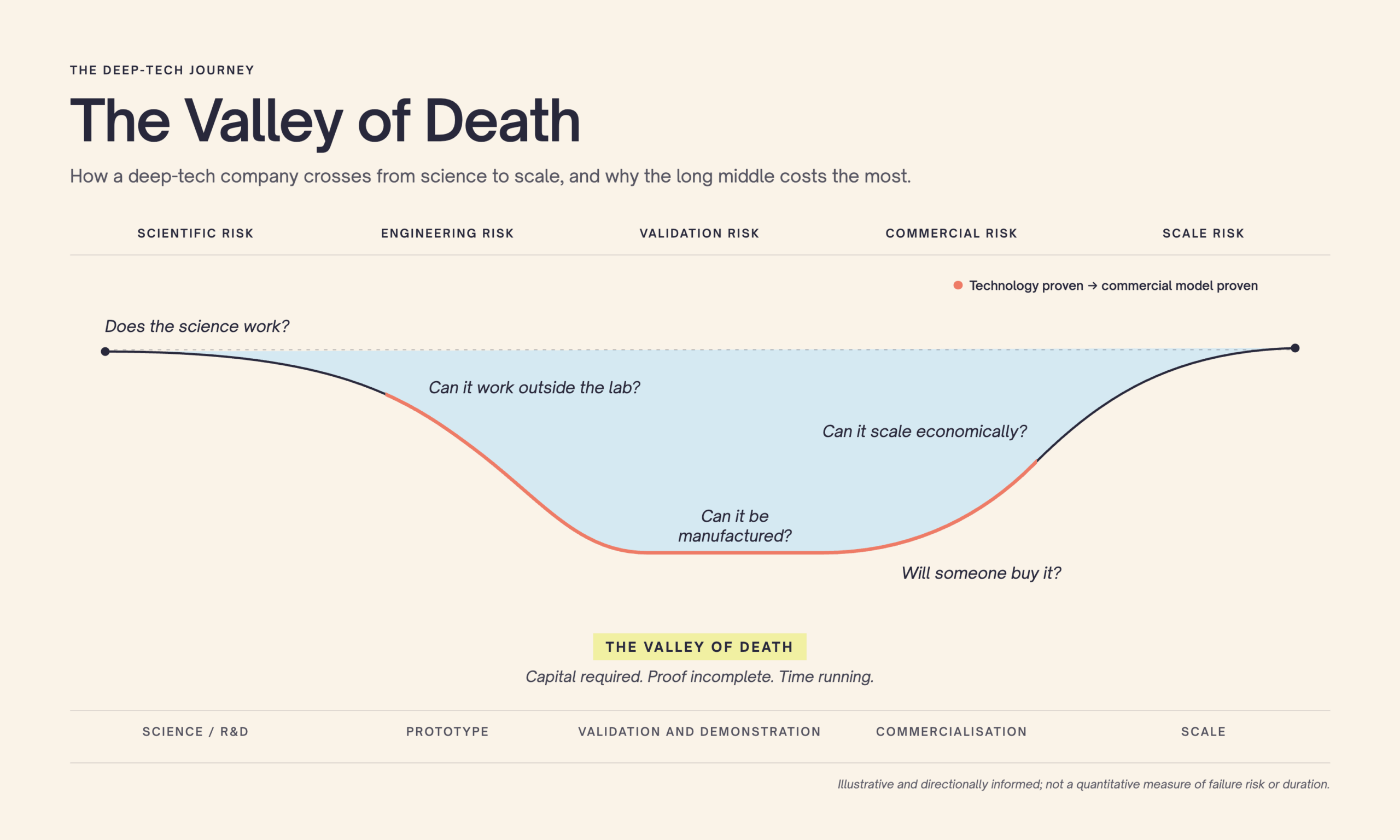
A deep-tech startup has more to prove before it earns the privilege of worrying about product-market fit. The science has to work. Then the engineering. The prototype has to survive outside the lab, clear validation and certification, and eventually be manufactured at viable economics. Only then do the familiar questions fully arrive: will someone buy it, and can it scale?
Deep tech, in other words, has to repeatedly prove the technology on its way to proving the business. And at every one of those stages, a company can run out of time, money or both.
That is the Valley of Death. It is hardly unique to deep tech, but here it takes a different shape. It starts earlier, lasts longer, and the risks change as a company moves through it. And, perhaps most interestingly for us, the terrain changes depending on where in the world you are trying to cross it.
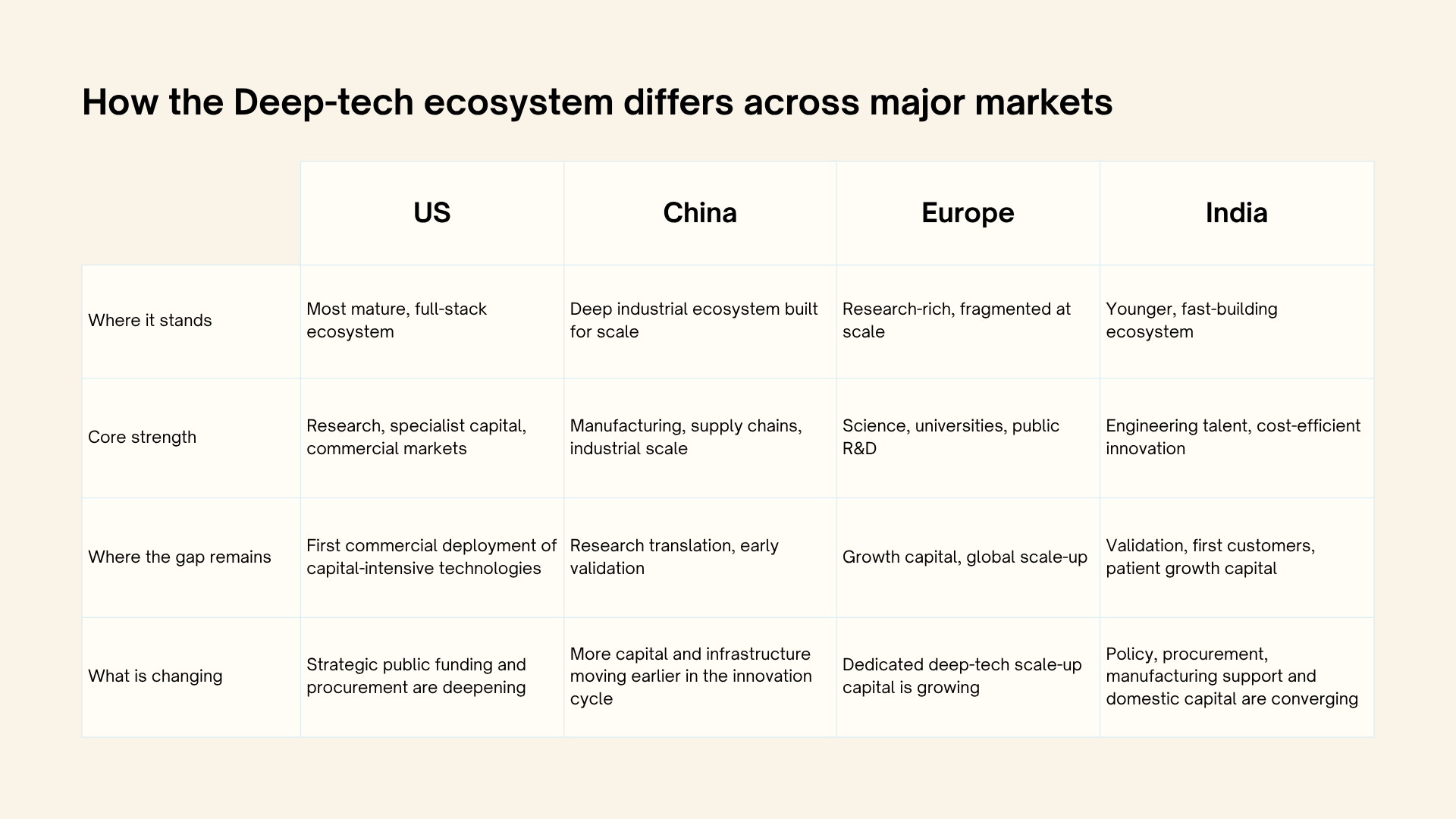
The Valley exists everywhere, but its shape is not universal. The US has perhaps the most complete system around it, from research and specialist capital to government demand and growth markets. China brings enormous industrial and manufacturing depth. Europe has exceptional science but a more difficult scale-up environment. India is younger, with strong engineering talent but much of the machinery around validation, first customers and patient growth capital still being built.
In other words, countries are not trying to solve the same problem at the same point in the journey.
By now, you would have to be trying rather hard not to notice Indian deep tech. For many of us growing up, space meant NASA; for a child in India today, ISRO is just as naturally part of that imagination. Semiconductors have entered mainstream conversation, private companies are building rockets and defence systems, and technologies that once felt rather distant are increasingly being built closer to home.
The numbers suggest something more substantial is underway. More than 85% of the $11.4 billion invested in Indian deep tech since 2015 has arrived in just the past six years, with 2025 marking a record year. At the same time, the ₹1 lakh crore RDI Scheme, specialist private capital and a growing set of commercially validated companies are beginning to change the machinery around them.
But growth is the easy part to see. The harder question is what all of this has actually done to India’s Valley of Death. Where does Indian technology still struggle on its way from invention to commercial scale, where has the crossing become easier, and how far have we really moved?
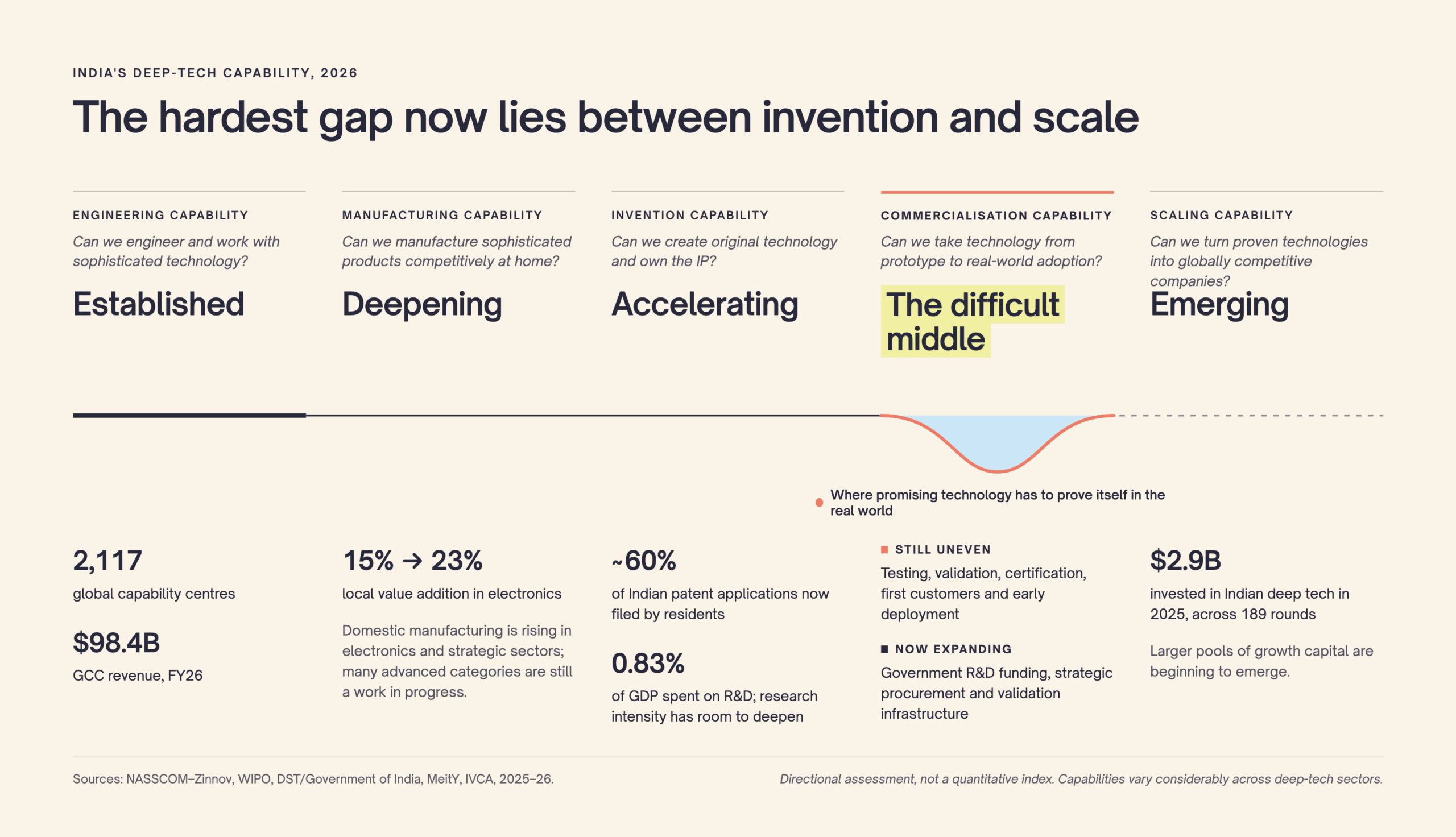
The good news is that this is not a static picture. Some of the hardest parts of the crossing are beginning to look different.
First, markets that were once largely the domain of the state are opening to private enterprise. Space is the clearest example. Private companies can now build launch vehicles, satellites and space infrastructure in areas once largely occupied by ISRO, while IN-SPACe was created specifically to enable and regulate private participation. Defence is moving in a similar direction, bringing startups and private companies deeper into technology development and procurement.
Second, the state is moving closer to technology. In defence and space, the government is rarely only the policymaker. It can also provide the infrastructure to develop, test and validate technology, and eventually become the customer. iDEX alone had signed 551 design and development contracts by March 2026, while IN-SPACe and ISRO are opening similar pathways in space.
Third, the route to a first customer is becoming clearer. This matters because a technology can work beautifully and still have no commercial proof until somebody agrees to use it. The iDEX funnel offers a useful glimpse of that progression: from hundreds of development contracts to 58 prototypes cleared for procurement and 45 signed orders worth ₹2,326 crore.
Fourth, capital is beginning to follow companies further across. Deep tech needs larger cheques precisely while uncertainty remains high. The RDI Scheme is explicitly targeting that gap, with ₹2,192 crore of support approved for its first 22 projects by July 2026, while specialist private funds are beginning to write larger cheques.
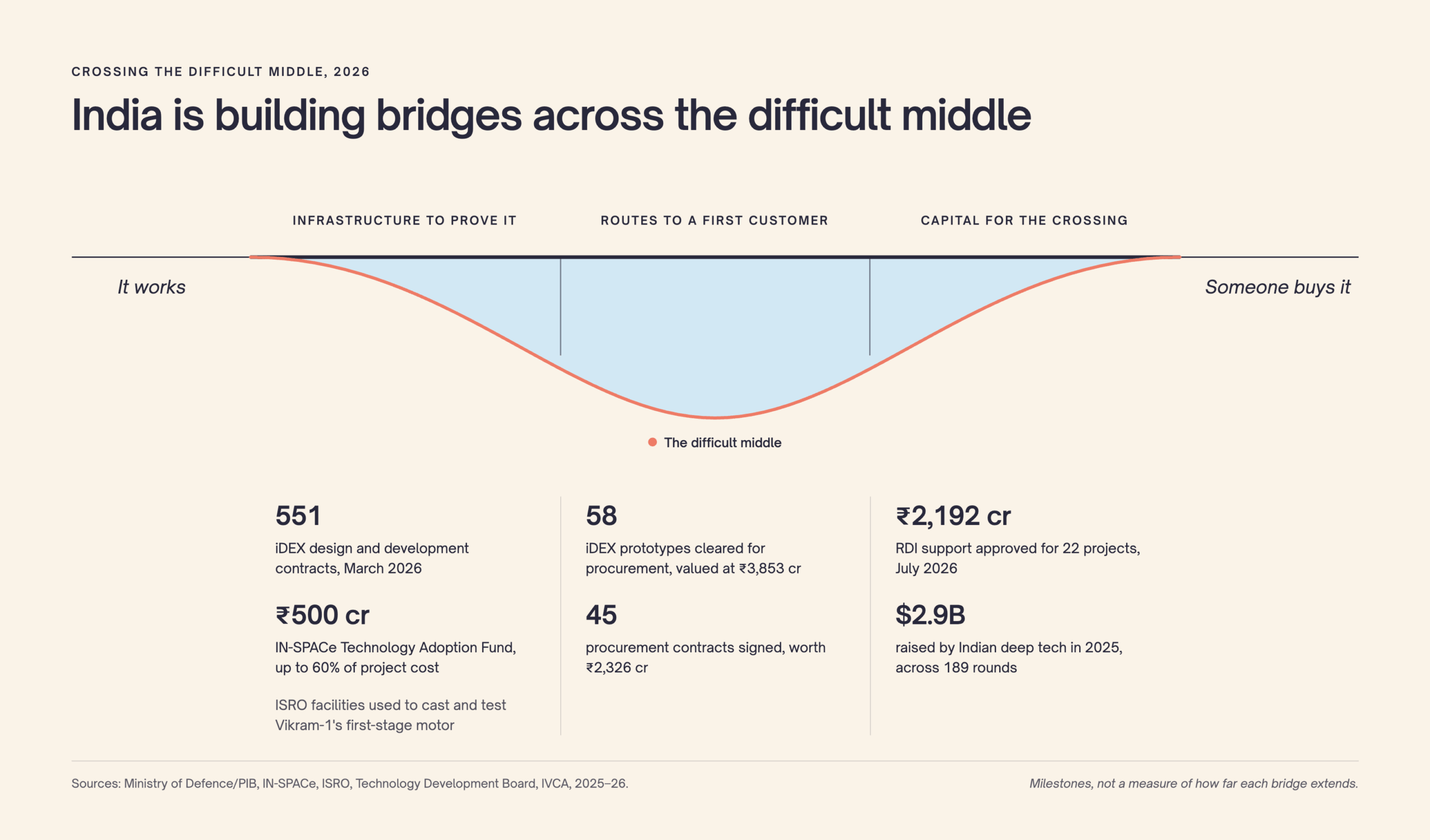
None of this means the difficult middle has disappeared. Moving from technical proof to commercial scale remains a demanding journey. What has changed is the architecture around it: more pathways to test and validate technology, clearer routes to first customers, and a broader pool of capital participating as companies move towards scale.
Getting a technology through validation and into deployment is an enormous achievement. It also creates the next problem almost immediately: scale. Factories have to be built, supply chains secured, working capital financed and global customers won. By now the technology is far less risky, but the capital it needs has only grown.
For those of us in Indian private markets, there is something familiar about this moment. We have watched successive industries take shape around us, and capital has been part of that journey: from software and financial services to consumer businesses, manufacturing and, more recently, the AI ecosystem. Each cycle has asked investors to understand a new kind of company, underwrite a different kind of risk and provide the capital required for the next stage of growth. Deep tech asks us to do that again, only this time the job is harder: we are being asked to underwrite the technology itself, and stay with it as it becomes an industry.
That changes what good capital looks like. That does not mean lowering the investment bar for deep tech. If anything, it raises it. It needs more patience, because validation and procurement don’t move on software timelines. It needs harder diligence, because investors must understand the IP, the manufacturing economics and how much technical risk genuinely remains. It needs larger follow-on cheques, because companies that prove their technology usually need more money, not less. And it needs credible paths to liquidity, because patient capital cannot mean permanent capital. That last gap is already visible: in IVCA’s survey of deep-tech funds, 62% named exit visibility as their biggest challenge, and more than half of exits so far have been secondary sales rather than IPOs.
Then there is the question of where that capital comes from. India now has far deeper pools of domestic wealth, and a private-markets ecosystem able to allocate them. As more strategic technologies are built here, deeper pools of Indian capital that understand them and can stay with them become increasingly important: family offices, AIFs, institutions, corporates and, eventually, public markets, forming a continuum from technical proof to global scale.
We are funding companies, but we are also helping build the kind of investment support deep tech in India needs to grow. That means understanding and pricing risk carefully, and backing companies that have shown they are ready to scale
The significance of a successful crossing goes well beyond the company that makes it. Deep-tech ecosystems are cumulative. A rocket company does not only build a rocket; it creates engineers who have solved propulsion problems, suppliers capable of manufacturing to new tolerances, testing infrastructure that can be used again, customers who better understand what domestic technology can do, and investors who have learnt how to underwrite the risk. The second company does not start where the first one did.
That is how technological capability gets built. Industries are rarely the product of a single breakthrough; they emerge as knowledge, infrastructure, supply chains, capital and institutions accumulate across successive generations of companies. Each one makes some part of the next journey cheaper, faster or simply possible.
India’s vaccine industry is a useful reminder. The capability that became so visible during COVID had been accumulating quietly for decades. Scientific institutions had been built, manufacturing expertise developed, supply chains established and people trained. When the moment came, India did not merely have access to vaccine technology; it had the scientific and industrial machinery to develop and manufacture vaccines at extraordinary scale.
Deep tech asks India to build that kind of accumulated capability across several technologies at once. And there is a powerful economic consequence to getting this right. The value created is not confined to the enterprise value of the companies that succeed. It sits in IP that remains in the country, specialised manufacturing capacity, a deeper supplier base, technical talent that moves through the ecosystem, domestic pools of informed capital and, eventually, entirely new industries built around capabilities that did not previously exist here.
Not every company will make it across the Valley, nor should it. The number of startups funded or rupees invested matters less than what each success leaves behind: talent, suppliers, facilities, IP and experience that make the next company easier to build
That is how a Valley becomes an ecosystem.
Jai Hind 🇮🇳


TERMS OF USE
Thank you for your interest in our Website at https://unlistedintel.com/. Your use of this Website, including the content, materials and information available on or through this Website (together, the “Materials”), is governed by these Terms of Use (these “Terms”). By using this Website, you acknowledge that you have read and agree to these Terms.
NO OFFER, SOLICITATION OR ADVICE
Our site is provided for informational purposes only. It does not constitute to constitute (i) an offer, or solicitation of an offer, to
purchase or sell any security, other assets, or service, (ii) investment, legal, business, or tax advice, or an offer to provide such advice or (iii) a basis for making any investment decision.
The Materials are provided for informational purposes and have been prepared by Oister Global for informational purposes to acquaint existing and prospective underlying funds, entrepreneurs, and other company founders with Oister Global's recent and historical investment activities.
Please note that any investments or portfolio companies referenced in the Materials are illustrative and do not reflect the performance of any Oister Global fund as a whole. There is no obligation for Oister Global to update or alter any forward-looking statements, whether as a result of new information, future events, or otherwise.
PURPOSE LIMITATION AND ACCESS TO YOUR PERSONAL DATA:
We will only collect your personal data in a fair, lawful, and transparent manner. We will keep your personal data accurate and up to date. We will process your personal data in line with your legal rights. We use your name and contact details, such as email, postal address, and contact number to continue communications with you. We may also use your contact information to invite you to events we are hosting or to keep you updated with our news.
USE OF COOKIES OR SIMILAR DEVICES
We use cookies on our website. This helps us to provide you with a better experience when you browse our website and also allows us to make improvements to our site. You may be able to change the preferences on your browser or device to prevent or limit your device’s acceptance of cookies, but this may prevent you from taking advantage of some of our features.
MATERIAL
The material displayed on our site is provided “as is”, without any guarantees, conditions, or warranties as to its accuracy, completeness, or reliability. You should be aware that a significant portion of the Materials includes or consists of information that has been provided by third parties and has not been validated or verified by us. In connection with our investment activities, we often become subject to a variety of confidentiality obligations to funds, investors, portfolio companies, and other third parties. Any statements we make may be affected by those confidentiality obligations, with the result that we may be prohibited from making full disclosures.
MISCELLANEOUS
This Website is operated and controlled by Oister Global in India. We may change the content on our site at any time. If the need arises, we may suspend access to our site, or close it indefinitely. We are under no obligation to update any material on our site.
CONTACT INFORMATION
Any questions, concerns or complaints regarding these Terms should be sent to info@oisterglobal.com







 Learn More