



TL;DR
Every time a high-profile IPO drops its DRHP, the same conversation plays out in Indian investing communities. Someone spots a large OFS component, and the verdict arrives quickly: “Promoters are dumping. Avoid.”
It’s one of the most widespread beliefs in Indian retail investing. And it’s worth examining more closely
If nobody can exit, nobody will invest. That is the thesis of this article. OFS is not a warning, it is the mechanism that keeps the startup funding cycle alive. The question worth asking isn’t whether someone is selling it’s what they’re charging you for the privilege.
OFS, or Offer for Sale, is a mechanism where existing shareholders, founders, early VCs, PE funds sell a portion of their stake to the public through the stock exchange. Unlike a fresh issue, where the company raises new capital for growth, an OFS transfers ownership of existing shares. The company gets no money. The selling shareholder does.
That’s where the retail instinct kicks in: “They know something we don’t.”
Sometimes, that’s true. But most of the time, they’re doing exactly what they were always supposed to do.
“An IPO is not just a fundraising event, it’s the final chapter of a VC investment.”
Here is how a typical startup funding story ends.
A VC fund invests in a startup in 2018. It takes years of capital, patience, and multiple funding rounds. By 2026, the company is mature enough to list. The fund is now in year 8 of a 10-year lifecycle. Its limited partners, pension funds, family offices, institutions have been waiting almost a decade for returns. The fund must start returning capital.
So when this VC sells shares in the IPO, retail investors call it a red flag. But ask the obvious question: if not at IPO, then when?
The IPO OFS is not panic selling. It is a decade of patient capital finally reaching its scheduled liquidity event. And if that exit is consistently punished by the market, the math for the next fund changes. Early-stage bets get smaller. Risk appetite shrinks. International VCs stay away. The pipeline of funded startups and the companies that become the IPOs of 2030 gets thinner.
“Every IPO exit funds the next startup.”
The data confirms this isn’t an edge case. Since 2012, OFS has made up more than half of all IPO fundraising in India in most years, peaking at 87% and sitting at 48% as recently as 2026. It is not an aberration. It is the structural norm of how Indian capital markets work.
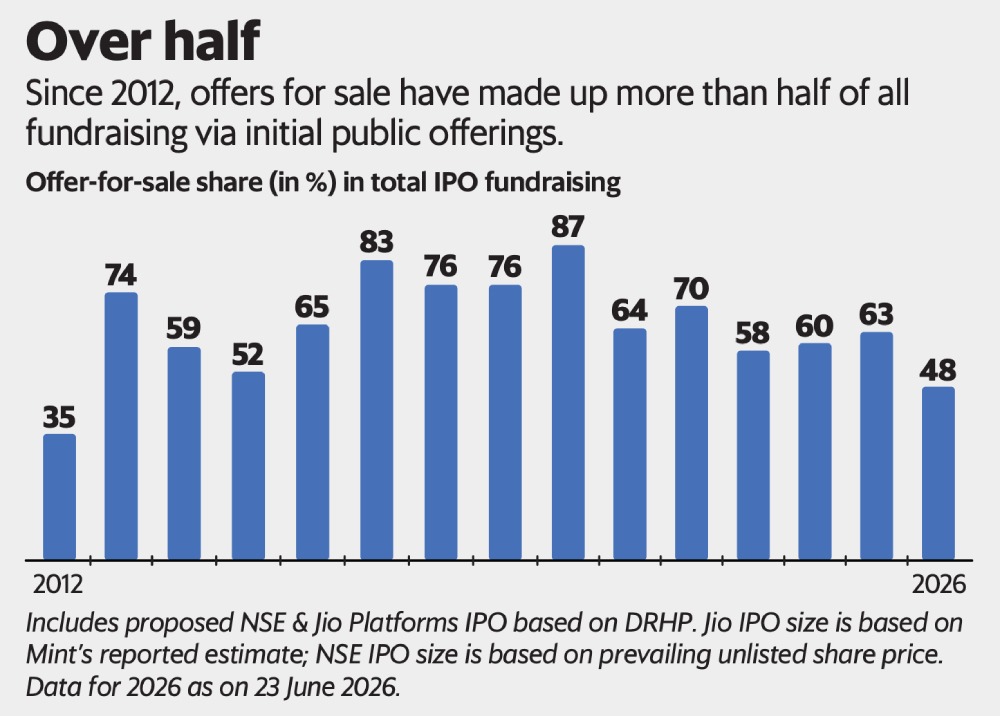
Source: Mint Newspaper 25th June 2026 pg 04
Here is a counterintuitive finding that reframes the entire OFS conversation.
While retail investors worry about OFS at IPO, sophisticated institutional money has been quietly moving in the opposite direction deliberately reducing OFS at IPO and exiting via post-listing block deals instead. Since 2024, OFS exits of about ₹59,000 crore were just one-third of the value realised through post-listing bulk and block deal exits.
In 2021, IPOs accounted for 12% of overall PE exits, with block trades at 23%. By 2025, IPO exits had shrunk to 8%, while block trades rose to 30%.
Institutions are holding back stakes at IPO, waiting for price discovery to mature, and exiting in the open market after listing. They are increasing their exit pressure just invisibly, after the retail investor has already bought in.
The exit that often concerns retail investors at IPO can, in practice, be far larger and far less visible in the months that follow.
“OFS isn’t a red flag. Irrational valuation is.”
This is the nuance most commentary misses entirely.
A company that doesn’t need fresh capital to grow doesn’t have to raise a fresh issue. If it’s profitable, cash-generative, and self-funding, it may come to market purely through OFS letting early investors exit while giving public investors access to an already-mature business.
In this case, a high OFS percentage may not be evidence of insiders fleeing . It’s a signal that the business has graduated beyond needing your money. It can stand on its own. The IPO is a liquidity event, not a rescue operation.
The NSE’s own proposed IPO, a purely OFS structure is one illustration of this.. The exchange isn’t raising growth capital. It simply has no need to. Its existing shareholders are offering the public a piece of a profitable, dominant business.Whether the valuation justifies that access is, as always, the more important question
Here is a simple way to read any IPO:
Fresh issue tells you where the money goes into the business, for growth, expansion, or debt repayment. OFS tells you who gets paid which existing shareholders are taking liquidity, and how much of their stake they’re selling. Valuation tells you how the market is pricing the business and that is the question that most directly drives returns.
Retail investors spend most of their attention on the second column. Professional investors spend almost all of theirs on the third.
There is a meaningful difference between a VC selling 15% of a profitable company at 30x earnings after an 8-year hold, and a promoter selling 60% of a loss-making company at 120x revenue six months after the last private round. The OFS percentage looks large in both cases. The investment case is completely different.
“OFS isn’t the variable. Valuation is.”
Some of the factors that experienced market observers tend to examine more closely: Valuation multiples relative to underlying fundamentals. The proportion of a promoter’s total personal holding being offered, not just a fund lifecycle exit. The presence or absence of fresh capital being raised alongside OFS in a loss-making business with no near-term path to profitability. The trajectory of unit economics across successive funding rounds.
These are the variables that tend to attract the most scrutiny. The OFS component, in isolation, rarely tells the full story.


TERMS OF USE
Thank you for your interest in our Website at https://unlistedintel.com/. Your use of this Website, including the content, materials and information available on or through this Website (together, the “Materials”), is governed by these Terms of Use (these “Terms”). By using this Website, you acknowledge that you have read and agree to these Terms.
NO OFFER, SOLICITATION OR ADVICE
Our site is provided for informational purposes only. It does not constitute to constitute (i) an offer, or solicitation of an offer, to
purchase or sell any security, other assets, or service, (ii) investment, legal, business, or tax advice, or an offer to provide such advice or (iii) a basis for making any investment decision.
The Materials are provided for informational purposes and have been prepared by Oister Global for informational purposes to acquaint existing and prospective underlying funds, entrepreneurs, and other company founders with Oister Global's recent and historical investment activities.
Please note that any investments or portfolio companies referenced in the Materials are illustrative and do not reflect the performance of any Oister Global fund as a whole. There is no obligation for Oister Global to update or alter any forward-looking statements, whether as a result of new information, future events, or otherwise.
PURPOSE LIMITATION AND ACCESS TO YOUR PERSONAL DATA:
We will only collect your personal data in a fair, lawful, and transparent manner. We will keep your personal data accurate and up to date. We will process your personal data in line with your legal rights. We use your name and contact details, such as email, postal address, and contact number to continue communications with you. We may also use your contact information to invite you to events we are hosting or to keep you updated with our news.
USE OF COOKIES OR SIMILAR DEVICES
We use cookies on our website. This helps us to provide you with a better experience when you browse our website and also allows us to make improvements to our site. You may be able to change the preferences on your browser or device to prevent or limit your device’s acceptance of cookies, but this may prevent you from taking advantage of some of our features.
MATERIAL
The material displayed on our site is provided “as is”, without any guarantees, conditions, or warranties as to its accuracy, completeness, or reliability. You should be aware that a significant portion of the Materials includes or consists of information that has been provided by third parties and has not been validated or verified by us. In connection with our investment activities, we often become subject to a variety of confidentiality obligations to funds, investors, portfolio companies, and other third parties. Any statements we make may be affected by those confidentiality obligations, with the result that we may be prohibited from making full disclosures.
MISCELLANEOUS
This Website is operated and controlled by Oister Global in India. We may change the content on our site at any time. If the need arises, we may suspend access to our site, or close it indefinitely. We are under no obligation to update any material on our site.
CONTACT INFORMATION
Any questions, concerns or complaints regarding these Terms should be sent to info@oisterglobal.com








 Learn More