



TL;DR
India’s startup ecosystem runs on a flywheel: a founder builds a company, the company exits through an IPO, acquisition, or secondary sale, that exit creates wealth for founders, employees, and early investors, and that wealth doesn’t sit still it becomes angel cheque, family office allocations, and LP commitments into AIFs and VC funds, which finance the next generation of startups, which produces the next exit. Every stage of that loop is now visible in the data: exit counts, ESOP payouts, family office growth, and AIF commitments. The result is a structural shift India’s private markets are becoming self financing rather than perpetually dependent on fresh foreign capital.
The clearest way to see India’s private markets is as a closed circuit, not a funnel. Capital doesn’t just flow in from outside; it circulates.
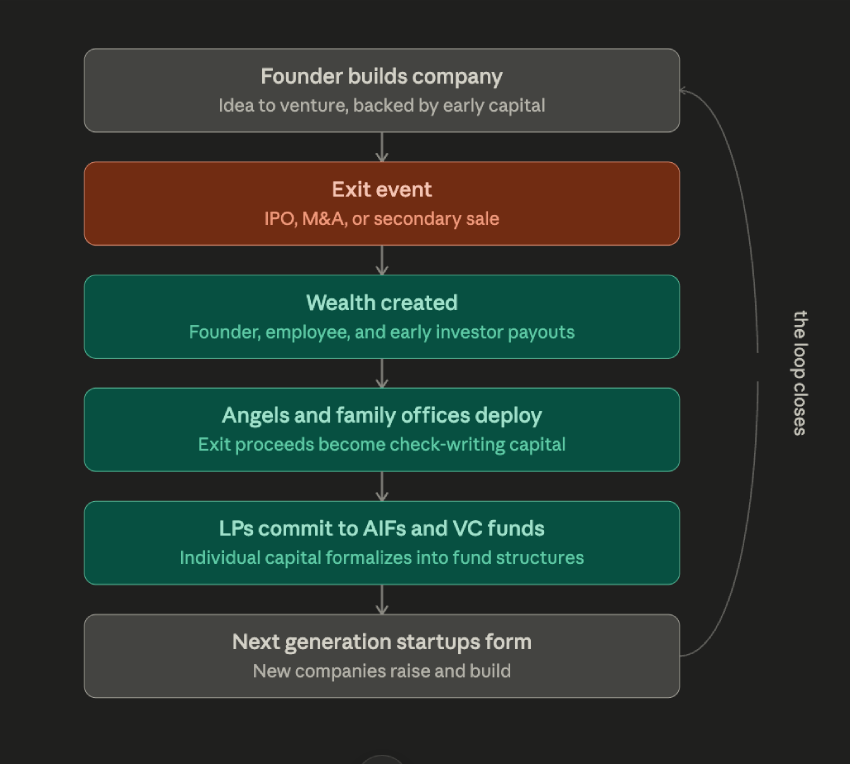
Founder builds company → exit event (IPO, M&A, secondary) → wealth created (founder, employee, investor) → angels and family offices deploy → LPs commit to AIFs and VC funds → next generation startups form → loop closes.
Every stage in that loop is a distinct, identifiable actor in India’s ecosystem today, and every stage now shows up in the data independently. That is the difference between a narrative and a mechanism and it is why the right question is no longer “how much capital is India attracting” but “how many times has this loop already turned.”
The loop starts where every startup story starts a founder building a company but it only becomes a flywheel at the exit. As of June 2026, 131 Indian startups have entered the unicorn club, with 27 having gone public and 5 acquired, and India’s unicorns have collectively raised over $118 billion. New unicorn creation has slowed since the 2021 peak, but that is the flywheel maturing, not stalling the ecosystem is producing fewer paper valuations and more actual liquidity events, which is precisely the input the rest of the loop depends on.
Most accounts of India’s startup wealth stop at founders and early investors. That misses a third of the story: employees.
ESOP monetization has quietly become one of the largest wealth creation channels in the ecosystem. In 2025 alone, startup employees monetized a record $1 billion through ESOPs via 16 IPOs up from $807 million across 10 listings in 2024 and just $39 million in 2023. Employees at Meesho, Groww, Urban Company, Pine Labs, and PhysicsWallah accounted for much of that figure. Buyback programs add a second channel: Q1 2026 alone saw $220 million in ESOP buybacks, already surpassing the totals for all of 2024 and 2025 combined, and total buyback liquidity since 2020 has crossed $2 billion across more than 100 companies.
This matters because employee wealth behaves differently from founder wealth. A founder who exits often becomes a fund manager or a marquee angel with a public profile. An employee who monetizes ESOPs is far more likely to become a first time angel, writing smaller, more numerous cheques into companies built by former colleagues which is exactly how Silicon Valley’s flywheel accelerated once PayPal, Google, and Meta alumni started funding each other’s next ventures. India is now early in that same transition: the generation of employees who joined startups between 2016 and 2020 is approaching a decade of tenure, holds meaningful vested equity, and is actively converting it to cash rather than waiting indefinitely for a single liquidity event.
Founder, employee, and investor wealth doesn’t stay idle; it moves into two formal channels.
The first is direct: angel checks and family office allocations. Inc42’s tracker has identified over 200 family offices now active in Indian startups, ranging from institutional names like Unilazer Ventures to founder led vehicles like Utsav Somani’s family office, built on his background as India partner at AngelList. The entry pattern is telling: most family offices began with cheques of ₹10–50 lakh and allocations of just 2–5% of the portfolio, investing through funds before some graduated to direct participation in the informal, earliest layer of the flywheel, largely invisible in official statistics.
The second channel is where that capital formalizes into scale: India’s Alternative Investment Fund industry.
| Metric | Data Point | Period |
|---|---|---|
| Total AIF commitments | ₹15.74 lakh crore | December 2025 |
| Domestic share, Category I & II AIFs | ~55.3% (up from ~50.3%) | Sept 2025 vs. March 2024 |
| Registered AIFs | 1,849 (+135% in 5 years) | March 2026 |
| Accredited investor base | 2,773 investors (+300% YoY) | FY26 |
The domestic share crossover from roughly half to a clear majority is the single most important number in this table, because it marks the point where the loop’s fifth stage stopped depending on external capital to close.
SEBI’s recent reforms read less like routine housekeeping and more like plumbing designed specifically for this flywheel. The removal of “angel tax” from April 1, 2025 freed up valuation flexibility for exactly the kind of informal, early stage angel checks described above. The September 2025 amendment recast Angel Funds around accredited investors, and the November 2025 amendment created the Accredited Investors Only Fund category while cutting the Large Value Fund minimum from ₹70 crore to ₹25 crore explicitly lowering the bar for smaller pools of newly wealthy domestic investors to combine into institutional scale vehicles. Each rule change targets a different joint in the same loop: making it easier for exit wealth to become angel capital, and easier for angel capital to become fund capital.
The most mature private markets are not those that attract the most foreign capital. They are the ones where every successful exit finances the next generation of founders, investors, and fund managers. When capital begins circulating inside an ecosystem rather than simply flowing into it, a startup ecosystem stops being a destination for outside money and becomes a permanent economic institution, one that keeps producing new founders, new funds, and new exits, regardless of what foreign capital decides to do next.


TERMS OF USE
Thank you for your interest in our Website at https://unlistedintel.com/. Your use of this Website, including the content, materials and information available on or through this Website (together, the “Materials”), is governed by these Terms of Use (these “Terms”). By using this Website, you acknowledge that you have read and agree to these Terms.
NO OFFER, SOLICITATION OR ADVICE
Our site is provided for informational purposes only. It does not constitute to constitute (i) an offer, or solicitation of an offer, to
purchase or sell any security, other assets, or service, (ii) investment, legal, business, or tax advice, or an offer to provide such advice or (iii) a basis for making any investment decision.
The Materials are provided for informational purposes and have been prepared by Oister Global for informational purposes to acquaint existing and prospective underlying funds, entrepreneurs, and other company founders with Oister Global's recent and historical investment activities.
Please note that any investments or portfolio companies referenced in the Materials are illustrative and do not reflect the performance of any Oister Global fund as a whole. There is no obligation for Oister Global to update or alter any forward-looking statements, whether as a result of new information, future events, or otherwise.
PURPOSE LIMITATION AND ACCESS TO YOUR PERSONAL DATA:
We will only collect your personal data in a fair, lawful, and transparent manner. We will keep your personal data accurate and up to date. We will process your personal data in line with your legal rights. We use your name and contact details, such as email, postal address, and contact number to continue communications with you. We may also use your contact information to invite you to events we are hosting or to keep you updated with our news.
USE OF COOKIES OR SIMILAR DEVICES
We use cookies on our website. This helps us to provide you with a better experience when you browse our website and also allows us to make improvements to our site. You may be able to change the preferences on your browser or device to prevent or limit your device’s acceptance of cookies, but this may prevent you from taking advantage of some of our features.
MATERIAL
The material displayed on our site is provided “as is”, without any guarantees, conditions, or warranties as to its accuracy, completeness, or reliability. You should be aware that a significant portion of the Materials includes or consists of information that has been provided by third parties and has not been validated or verified by us. In connection with our investment activities, we often become subject to a variety of confidentiality obligations to funds, investors, portfolio companies, and other third parties. Any statements we make may be affected by those confidentiality obligations, with the result that we may be prohibited from making full disclosures.
MISCELLANEOUS
This Website is operated and controlled by Oister Global in India. We may change the content on our site at any time. If the need arises, we may suspend access to our site, or close it indefinitely. We are under no obligation to update any material on our site.
CONTACT INFORMATION
Any questions, concerns or complaints regarding these Terms should be sent to info@oisterglobal.com








 Learn More