


TL;DR
The NPCI 30% cap limits any third-party UPI app to a maximum of 30% of total UPI transaction volume, on a rolling three-month basis. Introduced in November 2020 and extended twice most recently to December 31, 2026 the rule is designed to prevent monopolistic concentration in India’s public payments infrastructure.
Key mechanism: Once a provider crosses 30%, it must stop onboarding new customers. Existing users are unaffected. The cap targets future growth, not current usage. Industry executives have noted that NPCI itself views the cap as increasingly difficult to enforce without disrupting user experience at scale which is precisely why the deadline has been extended twice. The question is no longer whether it takes effect, but when the market begins pricing it in.
WhatsApp Pay holds just ~0.65% despite 500 million Indian users.
With India targeting 300 million new digital payment users in coming years, and dominant players facing a growth ceiling, those users must flow somewhere. The cap converts a winner-take-all market into one with structural room for new entrants.
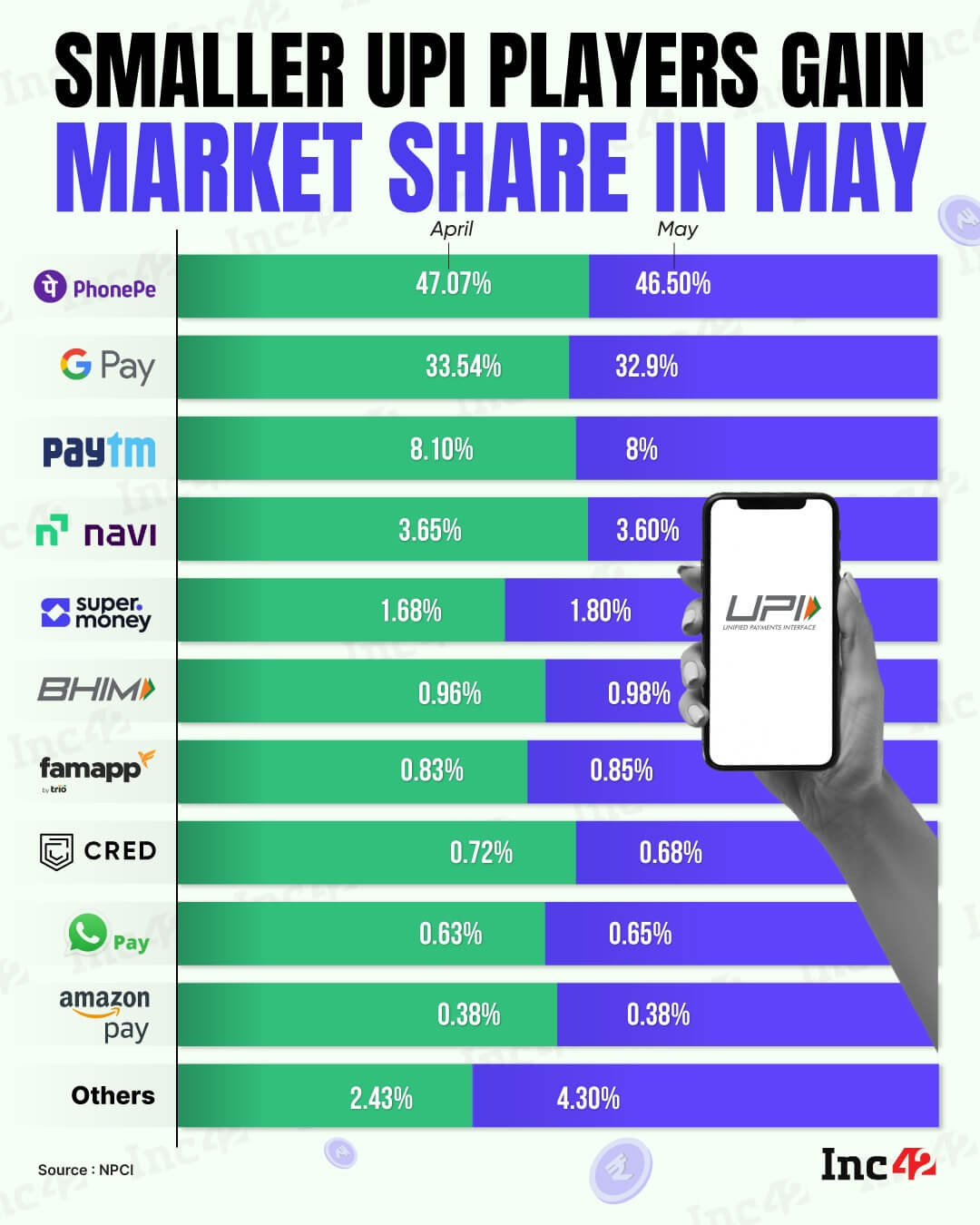
Data Source : https://www.npci.org.in/product/ecosystem-statistics/upi
Image Source : https://www.instagram.com/p/DZzzifsjudG/
Regulation of this kind doesn’t produce overnight change. PhonePe and Google Pay have built genuine moats: entrenched merchant acceptance networks, years of ingrained user habit, and deep Android integration. The 30% cap will not displace those advantages.
What it does is change the direction of the new flow. UPI crossed 22 billion transactions per month in 2026. When dominant players hit their growth ceiling, the next cohort of users must find alternatives. The opportunity is not in dislodging PhonePe’s existing base. It is in capturing what comes next.
Smaller players are already moving. At an April 2026 meeting with NPCI, Amazon Pay, CRED, Navi, Super.money, and Mobikwik proposed fresh curbs on market leaders’ acquisition tactics including restrictions on UPI ID mapper solicitation and a ban on targeting app downloads using contact book data. The challengers aren’t waiting for December 2026. They’re lobbying to accelerate the reset now.
Meta already owns three assets most fintech challengers spend years acquiring:
The missing layer is payments. WhatsApp Pay exists but has never achieved behavioural adoption. It processes approximately 100 million transactions per month against 22 billion for the entire UPI ecosystem. The infrastructure works. The habit hasn’t formed.
In June 2026, Meta invested $900 million in CRED at a $4.5 billion post-money valuation, acquiring roughly a 20% minority stake through a mix of primary and secondary share purchase, plus $100 million in ad credits. As part of the transaction, CRED founder Kunal Shah stepped away from his operating role to become WhatsApp’s global head, succeeding Will Cathcart.
His value to Meta isn’t CRED’s valuation or fundraising history. It is a proven ability to change how people relate to money. CRED built a platform where paying a credit card bill on time became an act of financial identity not obligation. Its 17 million monthly active members carry a minimum 750 credit score and process over 40% of all credit card bill payments in India. That is the behavioural architecture Meta needs to unlock WhatsApp Pay’s latent potential across a user base thirty times larger.
None of this guarantees a swift change in market dynamics. Habit is the most durable moat in consumer finance. A merchant with a PhonePe QR code on their counter has no immediate reason to replace it. A consumer who has paid with Google Pay for four years will not switch because a regulator made room for a competitor.
The 30% cap creates an opening. It does not guarantee anyone walks through it. Execution product quality, trust-building, merchant onboarding is the variable that determines which challengers convert regulatory space into real market share. WhatsApp Pay’s 0.65% share after years of operation is a reminder that distribution alone is not enough.
India’s payments market is entering a regulatory reset. The NPCI’s 30% cap restructures where future growth can flow not by forcing user migration, but by redirecting new adoption. Players best positioned for that redirection are those with distribution, identity infrastructure, and the demonstrated ability to change financial behaviour at scale.


TERMS OF USE
Thank you for your interest in our Website at https://unlistedintel.com/. Your use of this Website, including the content, materials and information available on or through this Website (together, the “Materials”), is governed by these Terms of Use (these “Terms”). By using this Website, you acknowledge that you have read and agree to these Terms.
NO OFFER, SOLICITATION OR ADVICE
Our site is provided for informational purposes only. It does not constitute to constitute (i) an offer, or solicitation of an offer, to
purchase or sell any security, other assets, or service, (ii) investment, legal, business, or tax advice, or an offer to provide such advice or (iii) a basis for making any investment decision.
The Materials are provided for informational purposes and have been prepared by Oister Global for informational purposes to acquaint existing and prospective underlying funds, entrepreneurs, and other company founders with Oister Global's recent and historical investment activities.
Please note that any investments or portfolio companies referenced in the Materials are illustrative and do not reflect the performance of any Oister Global fund as a whole. There is no obligation for Oister Global to update or alter any forward-looking statements, whether as a result of new information, future events, or otherwise.
PURPOSE LIMITATION AND ACCESS TO YOUR PERSONAL DATA:
We will only collect your personal data in a fair, lawful, and transparent manner. We will keep your personal data accurate and up to date. We will process your personal data in line with your legal rights. We use your name and contact details, such as email, postal address, and contact number to continue communications with you. We may also use your contact information to invite you to events we are hosting or to keep you updated with our news.
USE OF COOKIES OR SIMILAR DEVICES
We use cookies on our website. This helps us to provide you with a better experience when you browse our website and also allows us to make improvements to our site. You may be able to change the preferences on your browser or device to prevent or limit your device’s acceptance of cookies, but this may prevent you from taking advantage of some of our features.
MATERIAL
The material displayed on our site is provided “as is”, without any guarantees, conditions, or warranties as to its accuracy, completeness, or reliability. You should be aware that a significant portion of the Materials includes or consists of information that has been provided by third parties and has not been validated or verified by us. In connection with our investment activities, we often become subject to a variety of confidentiality obligations to funds, investors, portfolio companies, and other third parties. Any statements we make may be affected by those confidentiality obligations, with the result that we may be prohibited from making full disclosures.
MISCELLANEOUS
This Website is operated and controlled by Oister Global in India. We may change the content on our site at any time. If the need arises, we may suspend access to our site, or close it indefinitely. We are under no obligation to update any material on our site.
CONTACT INFORMATION
Any questions, concerns or complaints regarding these Terms should be sent to info@oisterglobal.com








 Learn More