



For decades, space exploration was governed strictly as a state monopoly under the Indian Space Research Organisation (ISRO). However, following the 2020 space-sector liberalisation and the Indian Space Policy, India’s private spacetech ecosystem has transitioned from experimental suborbital testing to demonstrated orbital execution.
With Hyderabad-based space unicorn Skyroot Aerospace successfully executing its maiden orbital mission (Mission Aagaman), India has joined an elite club of nations—alongside the United States and China—holding proven private orbital launch capabilities.
As institutional allocators and venture growth funds evaluate the sector, India’s private space industry is pivoting from a research-driven ecosystem into a $44 billion commercial infrastructure asset class.
One of the most compelling investment theses for Indian spacetech lies in its unmatched capital efficiency.

Skyroot achieved both suborbital and orbital commercial capabilities after raising ~$160 million in cumulative capital. By contrast, European peer Isar Aerospace (Germany) raised over $580 million across its funding rounds without yet completing an orbital launch.
This extreme cost-advantage stems from several structural tailwinds:
For venture capital and private equity allocators, this provides significantly higher return-on-invested-capital (ROIC) margins compared to Western launch startups.
While orbital rockets command the headlines, the broader space economy spans upstream hardware manufacturing and high-margin downstream space-data applications.
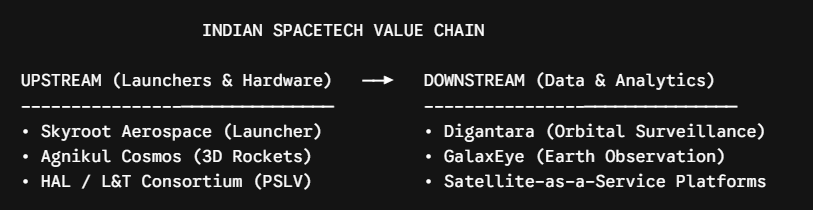
India’s space economy is projected to leap from $8.4 billion to $44 billion by 2033–2035. Achieving this 5-fold expansion requires a dual push from regulatory frameworks and institutional risk capital.
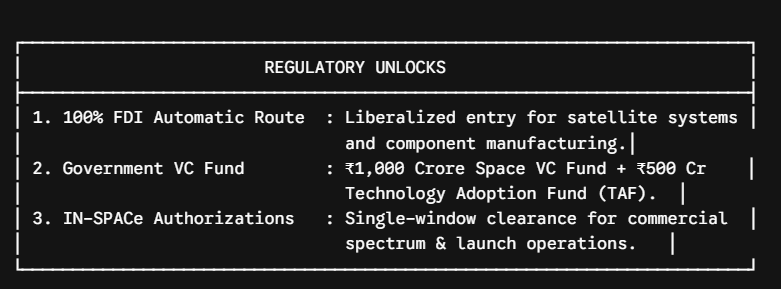
For the private space ecosystem to reach maturity over the next 5 years, India must mirror the “NASA Playbook”. In the US, NASA and the Department of Defense acted as the primary anchor customer for SpaceX and Rocket Lab via multi-billion-dollar long-term procurement contracts.
Industry bodies (such as the Indian Space Association) are advocating for Indian defense, intelligence, and civil infrastructure ministries to mandate indigenous satellite imagery, geospatial mapping, and launch services—guaranteeing predictable order books for private operators
For private equity, venture capital, and fund-of-funds allocators, spacetech in India is undergoing a fundamental re-rating:
India’s private space industry has officially cleared liftoff. The next phase will belong to fund managers and institutional allocators capable of funding the underlying supply chains, ground infrastructure, and satellite constellations powering the new orbital economy.


TERMS OF USE
Thank you for your interest in our Website at https://unlistedintel.com/. Your use of this Website, including the content, materials and information available on or through this Website (together, the “Materials”), is governed by these Terms of Use (these “Terms”). By using this Website, you acknowledge that you have read and agree to these Terms.
NO OFFER, SOLICITATION OR ADVICE
Our site is provided for informational purposes only. It does not constitute to constitute (i) an offer, or solicitation of an offer, to
purchase or sell any security, other assets, or service, (ii) investment, legal, business, or tax advice, or an offer to provide such advice or (iii) a basis for making any investment decision.
The Materials are provided for informational purposes and have been prepared by Oister Global for informational purposes to acquaint existing and prospective underlying funds, entrepreneurs, and other company founders with Oister Global's recent and historical investment activities.
Please note that any investments or portfolio companies referenced in the Materials are illustrative and do not reflect the performance of any Oister Global fund as a whole. There is no obligation for Oister Global to update or alter any forward-looking statements, whether as a result of new information, future events, or otherwise.
PURPOSE LIMITATION AND ACCESS TO YOUR PERSONAL DATA:
We will only collect your personal data in a fair, lawful, and transparent manner. We will keep your personal data accurate and up to date. We will process your personal data in line with your legal rights. We use your name and contact details, such as email, postal address, and contact number to continue communications with you. We may also use your contact information to invite you to events we are hosting or to keep you updated with our news.
USE OF COOKIES OR SIMILAR DEVICES
We use cookies on our website. This helps us to provide you with a better experience when you browse our website and also allows us to make improvements to our site. You may be able to change the preferences on your browser or device to prevent or limit your device’s acceptance of cookies, but this may prevent you from taking advantage of some of our features.
MATERIAL
The material displayed on our site is provided “as is”, without any guarantees, conditions, or warranties as to its accuracy, completeness, or reliability. You should be aware that a significant portion of the Materials includes or consists of information that has been provided by third parties and has not been validated or verified by us. In connection with our investment activities, we often become subject to a variety of confidentiality obligations to funds, investors, portfolio companies, and other third parties. Any statements we make may be affected by those confidentiality obligations, with the result that we may be prohibited from making full disclosures.
MISCELLANEOUS
This Website is operated and controlled by Oister Global in India. We may change the content on our site at any time. If the need arises, we may suspend access to our site, or close it indefinitely. We are under no obligation to update any material on our site.
CONTACT INFORMATION
Any questions, concerns or complaints regarding these Terms should be sent to info@oisterglobal.com








 Learn More