


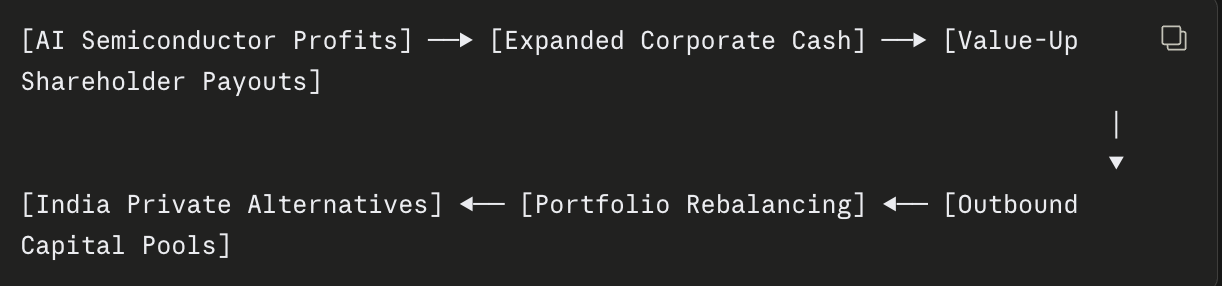
The expansion of South Korea’s KOSPI index through H1 2026 has increased the pool of capital available for overseas alternative asset allocations. Driven by concentration in High Bandwidth Memory (HBM) hardware and regulatory progress under the Corporate Value Up Program, rising corporate cash generation has increased liquidity available for outbound investment. This note evaluates how that capital may flow into India’s private equity, venture capital, and private debt markets, benchmarks India against competing destinations, and reviews the frictions governing execution.
The KOSPI index hit an intraday 52 week high of 9,385.59 in mid June 2026 before a roughly 11.5% technical consolidation, closing at 8,303.41 on July 1. The index carries acute concentration: Samsung Electronics and SK Hynix together represent approximately 52% of total KOSPI market cap, per exchange composition data. AI hardware demand has driven earnings growth that has outpaced broader regional macro indicators, with sell side projections pointing to annualized earnings growth approaching 300% in the memory semiconductor vertical specifically.
Valuations remain compressed relative to prior global tech cycles: over 60% of KOSPI listed companies still trade below 1.0x Price to Book, and forward P/E for pure play memory manufacturers sits near 5.0x the “Korea Discount” the Value Up Program targets.
The rebalancing mechanism: drawdowns typically freeze commitments to illiquid alternatives; rapid public equity appreciation does the opposite. As liquid holdings outgrow illiquid ones, institutions running policy mandated target allocations can drift below their alternatives weighting. Restoring that target requires fresh private market commitments turning the rally into a deployment catalyst rather than a headwind.
Korean chaebols have historically traded at compressed valuations due to cross shareholdings, conservative payouts, and dilutive subsidiary listings. The FSC’s Value Up Program tightens subsidiary IPO dilution rules, offers tax incentives for buybacks, and requires shareholder return disclosures. On June 30, 2026, Hyundai Motor published its Value Up framework, targeting a minimum 35% Total Shareholder Return for 2025–2027. As of late June, 731 listed corporations over 83% of KOSPI market cap have filed formal governance frameworks under the program, per FSC filings, creating a trackable mechanism for previously trapped corporate cash to move into outbound allocation channels.
Allocators will size India against other destinations, each with advantages India doesn’t fully replicate:
| Destination | Target Asset Class | Advantage vs. India |
|---|---|---|
| United States | Late-stage tech & mega-cap PE | Deepest liquidity and mature exits, offset by highly competitive entry multiples. |
| Southeast Asia | Logistics & hard infrastructure | Closer manufacturing alignment, offset by shallower consumer markets and liquidity. |
| Japan | Mid-market buyouts & real estate | Stable, cash-yielding, mature legal infrastructure, offset by limited growth upside. |
India’s case rests on scale and decoupling, not outright superiority. Over five years, India has absorbed approximately $303 billion in private capital across 6,000+ transactions, per industry deal tracking data, enough scale to absorb large commitments without the capacity constraints of smaller emerging markets, though it doesn’t offset the other three markets’ liquidity, multiple, or governance advantages.
On June 18, 2026, KVCA and IVCA signed a bilateral MoU in Bengaluru, backed by Korea’s Ministry of SMEs and Startups and KVIC. This is non-binding, not an immediate capital commitment of $303B over 5 years. What it signals is intent: mid tier Korean investors have historically entered India indirectly, through global fund of funds or Western based syndicates, due to high search costs. The framework aims, over roughly 24 months, to build direct pathways standardized reporting, FEMA compliance coordination, a catalog of pre-vetted managers, and co-investment matching to increase direct corporate venture capital (CVC) participation. Execution against these goals, not the signing itself, will determine whether friction actually falls.


TERMS OF USE
Thank you for your interest in our Website at https://unlistedintel.com/. Your use of this Website, including the content, materials and information available on or through this Website (together, the “Materials”), is governed by these Terms of Use (these “Terms”). By using this Website, you acknowledge that you have read and agree to these Terms.
NO OFFER, SOLICITATION OR ADVICE
Our site is provided for informational purposes only. It does not constitute to constitute (i) an offer, or solicitation of an offer, to
purchase or sell any security, other assets, or service, (ii) investment, legal, business, or tax advice, or an offer to provide such advice or (iii) a basis for making any investment decision.
The Materials are provided for informational purposes and have been prepared by Oister Global for informational purposes to acquaint existing and prospective underlying funds, entrepreneurs, and other company founders with Oister Global's recent and historical investment activities.
Please note that any investments or portfolio companies referenced in the Materials are illustrative and do not reflect the performance of any Oister Global fund as a whole. There is no obligation for Oister Global to update or alter any forward-looking statements, whether as a result of new information, future events, or otherwise.
PURPOSE LIMITATION AND ACCESS TO YOUR PERSONAL DATA:
We will only collect your personal data in a fair, lawful, and transparent manner. We will keep your personal data accurate and up to date. We will process your personal data in line with your legal rights. We use your name and contact details, such as email, postal address, and contact number to continue communications with you. We may also use your contact information to invite you to events we are hosting or to keep you updated with our news.
USE OF COOKIES OR SIMILAR DEVICES
We use cookies on our website. This helps us to provide you with a better experience when you browse our website and also allows us to make improvements to our site. You may be able to change the preferences on your browser or device to prevent or limit your device’s acceptance of cookies, but this may prevent you from taking advantage of some of our features.
MATERIAL
The material displayed on our site is provided “as is”, without any guarantees, conditions, or warranties as to its accuracy, completeness, or reliability. You should be aware that a significant portion of the Materials includes or consists of information that has been provided by third parties and has not been validated or verified by us. In connection with our investment activities, we often become subject to a variety of confidentiality obligations to funds, investors, portfolio companies, and other third parties. Any statements we make may be affected by those confidentiality obligations, with the result that we may be prohibited from making full disclosures.
MISCELLANEOUS
This Website is operated and controlled by Oister Global in India. We may change the content on our site at any time. If the need arises, we may suspend access to our site, or close it indefinitely. We are under no obligation to update any material on our site.
CONTACT INFORMATION
Any questions, concerns or complaints regarding these Terms should be sent to info@oisterglobal.com







 Learn More