


The question at the heart of private-market secondaries, and why the answer matters more than ever.
Here’s a question for you.
You walk into a wine shop looking for a particular vintage. There are two identical bottles in front of you: same vineyard, same year, same label, same price. One has come directly from the distributor. The other belonged to a collector who has decided to sell it.
Which one do you reach for?
If you hesitated over the second bottle, chances are you started thinking not just about the wine, but about the person selling it. Why are they selling? Do they know something I don’t? (Come on, you know you’d wonder too.)
When information is incomplete, provenance, where something came from, who owned it, and how it arrived in front of us, can shape the way we perceive it. The object itself may be identical, but its history gives us another piece of information to process.
You’ve probably done this without noticing. A house is unexpectedly up for sale: why are they moving? A barely-used car is listed: what’s wrong with it? Someone quits what looked like a fantastic job: what did they know that everyone else didn’t? We are remarkably good at turning other people’s decisions into information of our own.
Why am I telling you this? Well, I have my reasons.
There’s a way of investing in private markets that works remarkably like that bottle of wine. It’s called a secondary: instead of putting fresh capital into a company in exchange for newly issued shares, you buy an existing stake from someone who already owns it.
And lately, a lot more investors seem to want in. Global secondary transaction volumes reached roughly $240 billion in 2025, up 48% from the year before, itself a record year. Dedicated secondary capital waiting to be deployed has climbed to $327 billion.
India is earlier in this journey, but the direction of travel is becoming difficult to miss. Secondary transactions reached roughly ₹37,700 crore last year, growing 32% year-on-year, while average deal sizes have increased almost fourfold since FY20.
And it isn’t just transaction volumes that are changing. Family offices, UHNIs, institutions are increasingly looking for ways to access private companies, just as a growing pool of founders, employees and early investors is looking for liquidity. In India, that is creating something private markets haven’t historically had at scale: a deeper market of willing buyers meeting willing sellers.
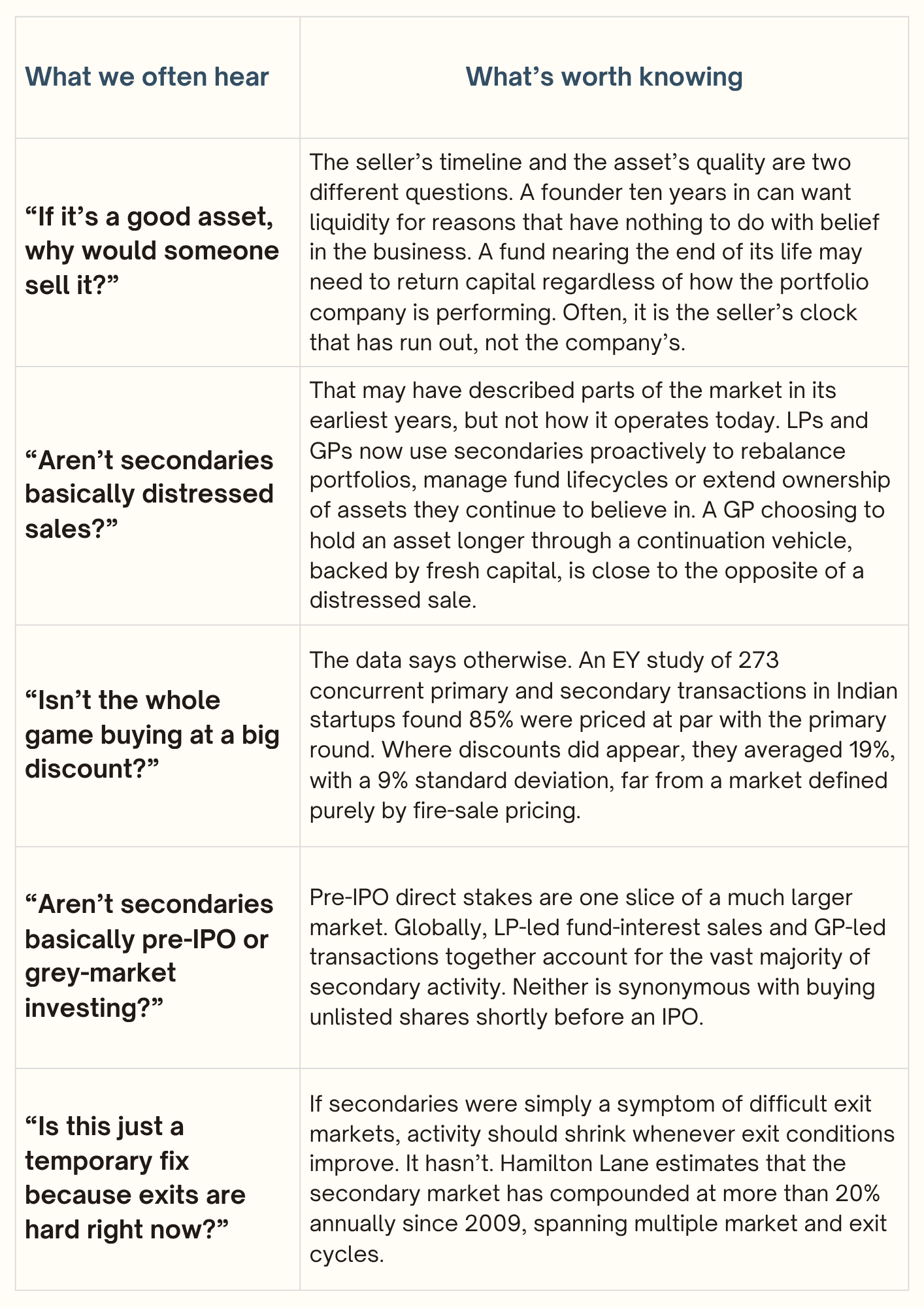
But there’s a curious contradiction hiding inside all this growth. Secondaries are attracting more capital, more investors and more attention and somehow, more myths too. In fact, look across how the strategy is discussed and the same questions keep resurfacing: Why would someone sell a good asset? Are secondaries just distressed opportunities? Is the appeal simply a discount?
And this is where secondaries get particularly interesting. Because chances are, you already participate in them.
Think about the last stock you bought. Unless you were participating in a fresh issuance, you weren’t buying shares from the company. You were buying them from another shareholder. Someone, somewhere, had decided to sell exactly what you had decided to buy. We rarely stop to wonder why.
Nobody buys Reliance and thinks, if this is such a good company, why was someone willing to sell it to me? We understand almost instinctively that the seller may need liquidity, may be rebalancing a portfolio, taking profits, or simply have a different view of what they want to own next. Their reason for selling and our reason for buying can coexist perfectly well.
That is, quite literally, a secondary transaction.
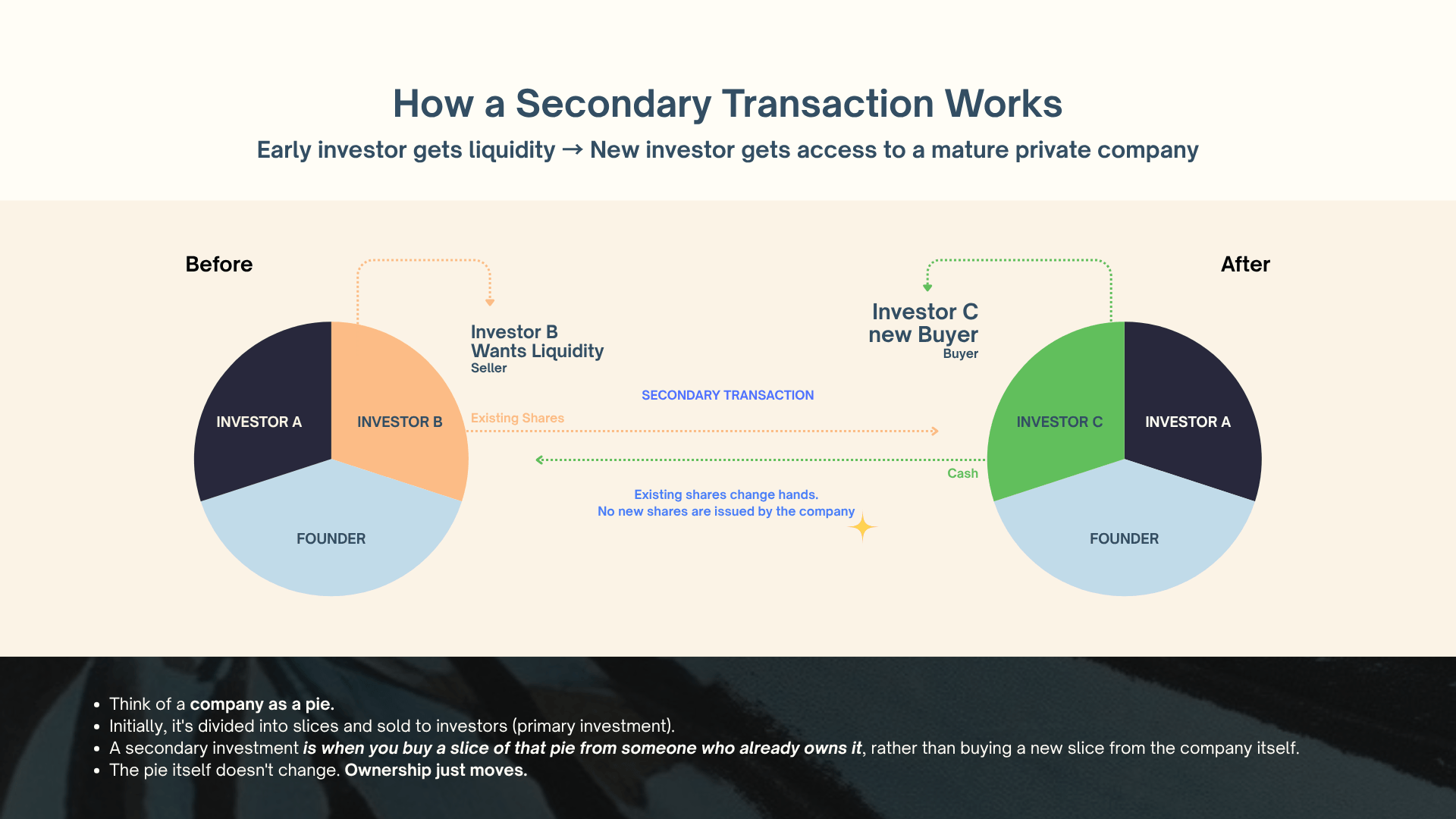
In fact, the overwhelming majority of everyday trading in public markets is secondary. The company doesn’t receive fresh capital every time its shares trade; existing ownership simply moves from one investor to another. Private-market secondaries are built on the same basic idea.
So perhaps the interesting question isn’t why do secondaries exist? We’ve already accepted their logic in public markets. The more interesting question is: why are they becoming so important in private markets now? And especially in India?
Part of the answer is simply timing. India has spent roughly the last decade building its private-market ecosystem in earnest. More than $400 billion of PE and VC capital has been deployed over that period, creating generations of venture-backed companies, fund portfolios and private ownership that are now reaching maturity.
And maturity creates a different capital opportunity. The first phase of an ecosystem is largely about getting capital in. Eventually, it also has to get good at getting capital out and moving it between investors with different time horizons.
That pressure is already visible. In 2025, PE and VC investors in India realised $32.9 billion across 257 exits, the second-highest exit value on record. But the composition is more revealing than the headline. Exit volumes fell 10% even as value rose, IPO-led exits declined even as some of India’s biggest IPOs are lined up on the horizon, and nearly half of all exit value came from strategic sales.
That is the real liquidity question for a maturing private market. An IPO or acquisition can provide an exit for everyone, but not every investor needs or wants to leave at the same time. And this begins to answer the question we started with: why would anyone sell a good asset?
Because sometimes, the asset isn’t the reason for the sale at all. A company may still have years of growth ahead just as an early investor reaches the end of its holding period. A fund may need to return capital while another investor is perfectly willing to own the same asset for the next five years. The investor’s timeline and the company’s timeline are not always the same.
That is precisely the gap secondaries are built to fill: one investor gets liquidity without requiring the asset itself to exit. From Zomato to Lenskart, angels have done secondaries in these startups and got 5x+ returns and the company has gone on to deliver another 5x+ in valuation post that and got listed too.
At Oister, we’ve had the privilege of watching this market develop from inside it. We are now raising the third fund in our ACE secondaries series, after two oversubscribed predecessors. And we’re increasingly in good company. Kenro Capital has built a dedicated growth-secondaries strategy, Neo and 360 ONE have announced sizeable secondary vehicles, and PixelSky is targeting a dedicated fund. The growing number of managers and the scale of capital being raised point to something larger: secondaries in India are developing an ecosystem of their own.
Every mature private-market ecosystem eventually needs a secondary market capable of keeping pace with the primary market that created it. India increasingly looks like it has reached that stage.
All of this explains why someone might sell a perfectly good asset. It doesn’t quite explain why another investor would want to buy it.
We have a fairly good window into that question. Across our conversations with LPs, family offices and wealth partners and now across three secondary funds of our own, a few reasons come up remarkably often.
First, you are investing with more of the story already written. A company that has spent seven or eight years building itself has more to show than it did in year two: revenues, customers, margins, management execution, subsequent funding rounds and, often, years of institutional scrutiny. In a fund secondary, much of the underlying portfolio may already be known. For the investor, there is simply more information available on which to make a decision.
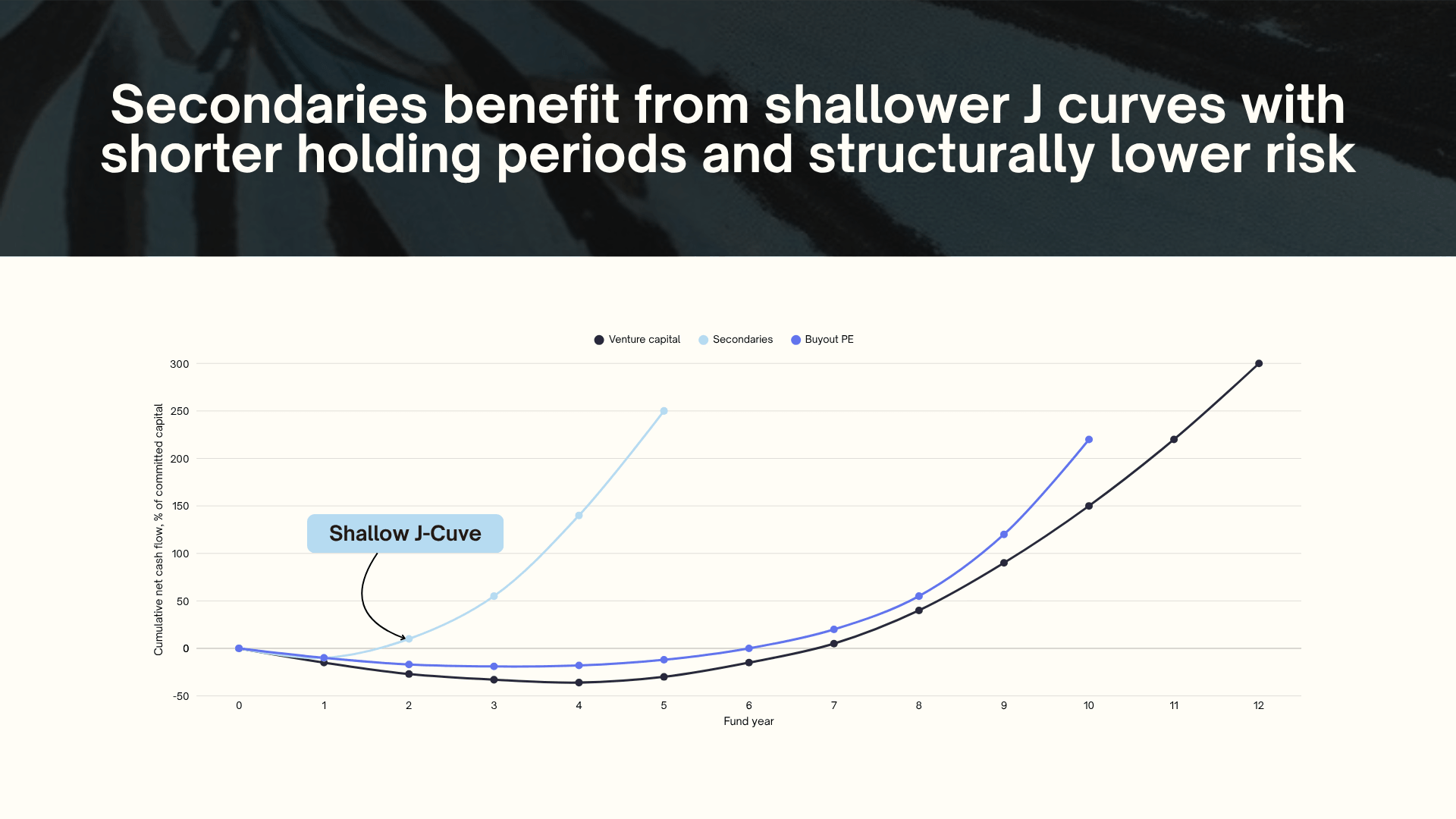
Second, you are typically entering later in the investment lifecycle. That can mean shorter remaining holding periods and a closer path to potential liquidity. It also changes one of the defining characteristics of private-market investing: the J-curve. Instead of entering at the beginning and waiting through years of deployment and value creation, a secondary investor enters after some of that journey has already taken place. Historically, that has translated into shallower J-curves and the potential for earlier distributions.
Third, secondaries can open doors that primary markets no longer do. A high-quality private company may not need to raise fresh capital, or an established fund manager may not have room for a new LP. But an existing shareholder or LP seeking liquidity creates another way in. For investors, secondaries can therefore provide access to companies, managers, vintages and portfolios that might otherwise have been unavailable.
And finally, the historical risk-return profile has been interesting. Global data has shown secondaries with lower dispersion of returns than several primary private-market strategies, alongside shorter holding periods and relatively low historical loss ratios. None of this determines what happens in the next transaction, of course. But it does help explain why institutional investors increasingly see secondaries as more than simply a source of liquidity for somebody else.
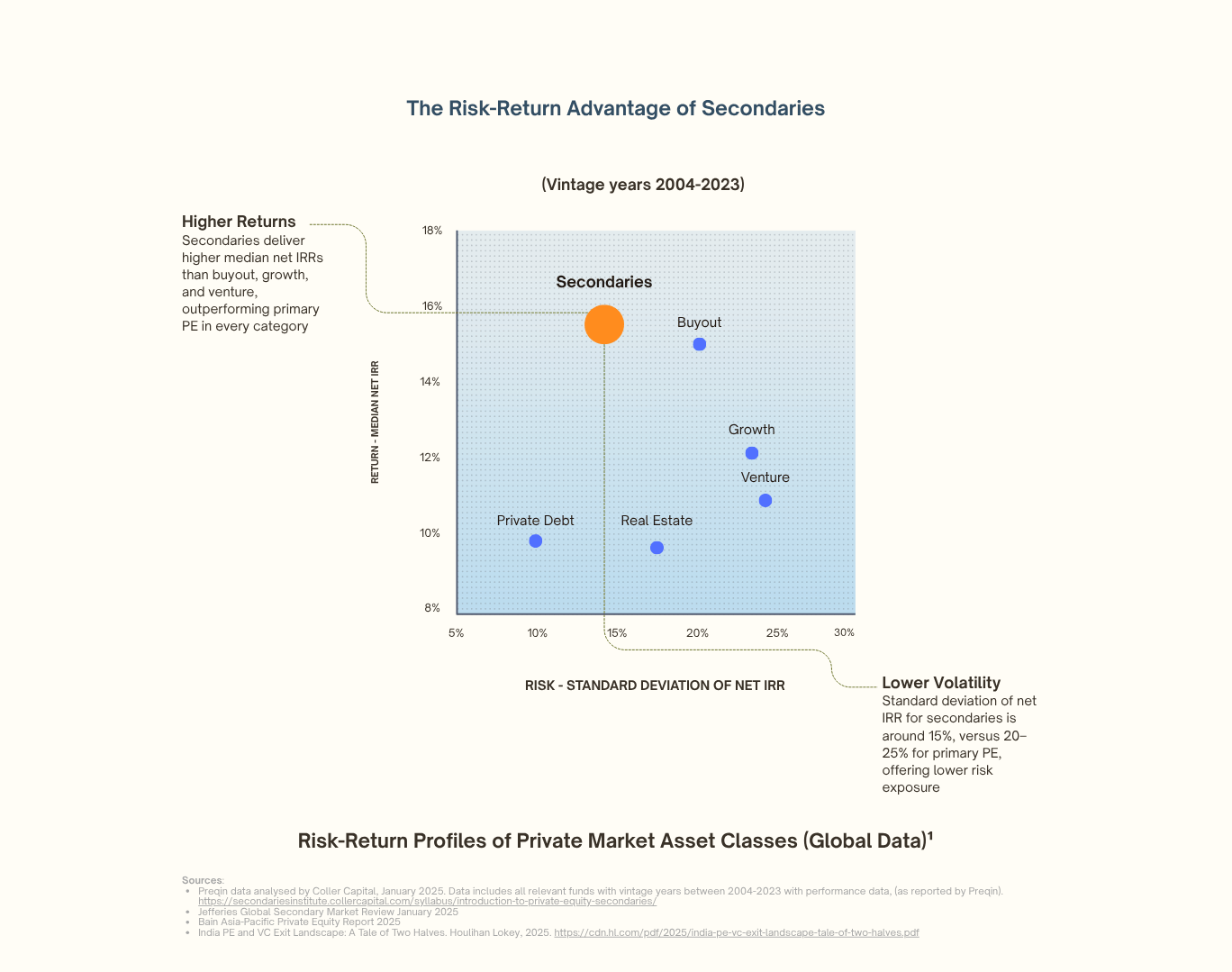
Put simply, you may know more about what you are buying, wait less of the asset’s overall journey, gain access to something you couldn’t access before, and potentially see capital come back earlier.
It is not difficult to see why that combination is attracting attention. But there is a catch, or, perhaps more accurately, an important qualifier. None of these advantages can rescue a bad asset.
First, start with the asset. The word secondary can distract from the most important question: would you want to own this asset in the first place? For a direct investment, that means looking at the business, its growth, economics, competitive position, management, governance and the quality of the cap table. For a fund secondary, it means looking through to the underlying portfolio: where the value sits, how concentrated it is, how those companies are performing and how much of their journey may still lie ahead. A secondary can create a different route into an investment; it cannot turn an average asset into a great one.
Second, understand why it is available. This takes us all the way back to the question we began with: why is somebody selling? The answer could be entirely ordinary, a fund nearing the end of its life, an early investor looking to realise returns, a founder seeking some liquidity, an employee monetising ESOPs or an LP rebalancing its portfolio. But seller motivation still deserves to be understood. The circumstances of the seller and the quality of the asset are two different questions, and both need diligence.
Third, price the asset, not the discount. A 20% discount sounds compelling. But 20% off what? A recent arm’s-length transaction is one reference point; a stale funding-round valuation or an old fund NAV is another. A large discount to an unrealistic valuation can still leave you overpaying. What ultimately matters is not how far the price has moved from some historical reference point, but how it compares with the value you believe sits underneath the asset today.
Fourth, underwrite the way out. One of the attractions of secondaries can be entering later in an asset’s journey, but that makes the path to liquidity particularly important. An IPO may be one route, but it should rarely be the only assumption. Strategic sales, buybacks, future secondary transactions and other liquidity events can all form part of the picture. The question is not simply whether an exit is expected, but what could realistically create it, on what timeline, and what happens to the investment case if that timeline stretches.
And then there is the transaction itself. Private shares do not change hands with the standardisation of listed stocks. Transfer restrictions, shareholder rights, preference structures, information rights, legal documentation and the precise security being acquired can all affect the economics of what an investor ultimately owns. In secondaries, diligence is not only about the asset; it is also about the terms on which that asset changes hands.
Asset. Seller. Price. Exit. Transaction. None of these questions is particularly exotic and perhaps that is the point. Secondaries may change when and how you enter a private investment, but they do not change the fundamentals of good investing. If anything, having more of the story already written gives you more to interrogate.
As mentioned earlier, secondaries seem to attract more than their fair share of myths. Across our conversations with investors and partners, a few come up more often than others.
I know, I know. Somewhere along the way, this edition of Unlisted turned into a rather thorough Secondaries 101. But perhaps that was necessary, because much of what makes secondaries interesting comes down to perception.
We began with a simple question: why would anyone sell a good asset?
After all of this, the answer is actually quite simple. Because a good asset and a good time to sell are not mutually exclusive. A founder may want liquidity. A fund may be reaching the end of its life. An LP may be rebalancing. An early investor may simply have achieved the return it came for. The asset can still have a compelling future even when one investor’s journey with it is complete.
Public markets taught us this a long time ago. At Oister, we see private markets increasingly developing the same ability for ownership to move between investors without that movement automatically becoming a judgment on the asset itself. Greater liquidity, more routes to access and broader domestic participation are all part of a market becoming deeper and more mature.
And maybe that is why this one deserved the 101 treatment. If you follow private markets, you are going to hear a lot more about secondaries. Better to know what you are looking at when you see one.
So perhaps we were asking only half the question all along.
It isn’t just, “Why are they selling?” It is also, “Do I want to buy?”
Thank you and see you next month.
Jai Hind


TERMS OF USE
Thank you for your interest in our Website at https://unlistedintel.com/. Your use of this Website, including the content, materials and information available on or through this Website (together, the “Materials”), is governed by these Terms of Use (these “Terms”). By using this Website, you acknowledge that you have read and agree to these Terms.
NO OFFER, SOLICITATION OR ADVICE
Our site is provided for informational purposes only. It does not constitute to constitute (i) an offer, or solicitation of an offer, to
purchase or sell any security, other assets, or service, (ii) investment, legal, business, or tax advice, or an offer to provide such advice or (iii) a basis for making any investment decision.
The Materials are provided for informational purposes and have been prepared by Oister Global for informational purposes to acquaint existing and prospective underlying funds, entrepreneurs, and other company founders with Oister Global's recent and historical investment activities.
Please note that any investments or portfolio companies referenced in the Materials are illustrative and do not reflect the performance of any Oister Global fund as a whole. There is no obligation for Oister Global to update or alter any forward-looking statements, whether as a result of new information, future events, or otherwise.
PURPOSE LIMITATION AND ACCESS TO YOUR PERSONAL DATA:
We will only collect your personal data in a fair, lawful, and transparent manner. We will keep your personal data accurate and up to date. We will process your personal data in line with your legal rights. We use your name and contact details, such as email, postal address, and contact number to continue communications with you. We may also use your contact information to invite you to events we are hosting or to keep you updated with our news.
USE OF COOKIES OR SIMILAR DEVICES
We use cookies on our website. This helps us to provide you with a better experience when you browse our website and also allows us to make improvements to our site. You may be able to change the preferences on your browser or device to prevent or limit your device’s acceptance of cookies, but this may prevent you from taking advantage of some of our features.
MATERIAL
The material displayed on our site is provided “as is”, without any guarantees, conditions, or warranties as to its accuracy, completeness, or reliability. You should be aware that a significant portion of the Materials includes or consists of information that has been provided by third parties and has not been validated or verified by us. In connection with our investment activities, we often become subject to a variety of confidentiality obligations to funds, investors, portfolio companies, and other third parties. Any statements we make may be affected by those confidentiality obligations, with the result that we may be prohibited from making full disclosures.
MISCELLANEOUS
This Website is operated and controlled by Oister Global in India. We may change the content on our site at any time. If the need arises, we may suspend access to our site, or close it indefinitely. We are under no obligation to update any material on our site.
CONTACT INFORMATION
Any questions, concerns or complaints regarding these Terms should be sent to info@oisterglobal.com








 Learn More