



TL;DR
The listing pop illusion is the mistaken belief that acquiring shares of a company before its IPO is itself the value capturing act. In reality, an IPO filing only starts a new phase of price discovery, mandatory lock-ins, and liquidity constraints that determines whether early access converts into realized return.
Investors who evaluate access models on structural grounds (diversification, secondary liquidity, underwriting rigor, regulatory wrapper) are positioned to capture that value; investors who evaluate only on “did I get in early” often are not.
Every cycle of marquee IPO filings an exchange operator, a telecom platform, a consumer unicorn produces the same retail behavior: a rush to acquire unlisted shares before the listing, on the assumption that early access alone is the trade. The logic feels intuitive: if a company is about to list at a materially higher valuation, owning shares beforehand should capture that gap.
The illusion lies in what “capturing” actually requires.
An IPO filing does not convert an unlisted position into cash. It converts it into a new asset with its own rules: allotment mechanics, price band anchoring, and in India specifically mandatory post listing lock-in periods mandated by SEBI for pre-IPO capital. The value may exist on paper well before the listing; whether it is ever realized depends on structural factors that have nothing to do with how early the shares were bought.
This is why unlisted market performance and single name IPO stories diverge so sharply. A broad basket of unlisted companies can post a double digit drawdown in a year when headline names are up multiples, because the basket reflects the average investor’s exposure to illiquidity and mispricing, not the best case outcome of the one name that made the news.
The most common entry point into unlisted equity is single name concentration: buying shares in one company ahead of one anticipated listing. This is structurally the opposite of how institutional private market exposure is built.
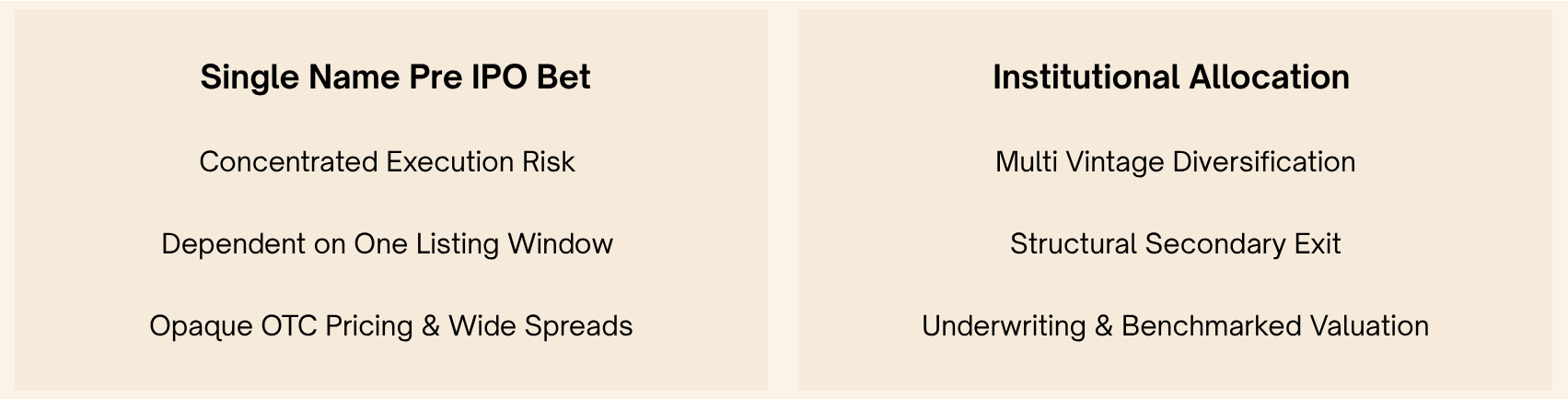
A single unlisted position ties an investor’s outcome to one company’s regulatory timeline, one listing window, and one post IPO price path. Delay the filing, and capital sits illiquid with no defined horizon. Miss the optimal exit window inside a mandatory SEBI lock in period, and a position that was up substantially on paper can give back most of its gain before it can legally be sold.
Diversified private market allocation across vintage years, sectors, and growth stages, typically through pooled fund structures decouples outcomes from any single listing event. The portfolio’s return depends on the broader private markets cycle, not on correctly timing one company’s IPO calendar.
Unlisted share transactions in India largely move through informal, broker intermediated, over the counter (OTC) channels. These channels are effective at sourcing access but weak at providing liquidity. Pricing is set by whatever counterparty is available at the moment, spreads are wide, and there is zero visibility into exit terms until a buyer actually appears.
This is the second half of the listing pop illusion: investors often assume liquidity will simply materialize once a company lists. In practice, SEBI mandated lock in rules (typically 6 months post listing for pre IPO investors) remove the investor’s ability to sell at the exact moment public market sentiment and price might be most favorable.
Structured secondary transactions address this asymmetry directly. Rather than treating liquidity as something to hope for post listing, secondary funds and GP led continuation vehicles build defined entry valuations and structured exit paths into the transaction itself, long before an exchange listing takes place. The liquidity problem is underwritten rather than assumed away.
Unlisted pricing is unusually sensitive to narrative. A company with limited float and high investor interest can trade at unlisted multiples that reflect scarcity and headline momentum rather than underlying unit economics. Investors buying at the peak of pre IPO chatter are often buying the narrative, not the fundamentals.
Institutional evaluation approaches this differently:
The IPO price band, once filed in the DRHP, becomes a reality check against the unlisted price an investor already paid, not the other way around.
How an unlisted position is held matters as much as which company it is in. Direct, off market transfer of physical or demat shares through unregistered intermediaries creates counterparty risk, unclear title, and tax complexity that only becomes visible at exit.
Category II Alternative Investment Fund (AIF) structures, regulated by SEBI, route the same underlying exposure through a pooled vehicle with institutional governance, defined reporting standards, and pass through tax treatment. The company being invested in doesn’t change the structural protection around that investment does.
| Evaluation Dimension | Informal / DIY Pre IPO Access | Structured Institutional Allocation |
|---|---|---|
| Position Sizing | Single name concentration risk | Multi-manager, multi-vintage diversification |
| Entry Pricing | Narrative driven, chatter anchored | Underwriting driven, benchmarked against comparables |
| Exit Visibility | Assumed to appear at IPO listing | Structured secondary transactions with defined terms |
| Liquidity Profile | Passive holding through mandatory lock-ins | Active portfolio liquidity management & early DPI focus |
| Regulatory Wrapper | Off-market OTC transfer via intermediaries | SEBI-registered Category II AIF with institutional governance |


TERMS OF USE
Thank you for your interest in our Website at https://unlistedintel.com/. Your use of this Website, including the content, materials and information available on or through this Website (together, the “Materials”), is governed by these Terms of Use (these “Terms”). By using this Website, you acknowledge that you have read and agree to these Terms.
NO OFFER, SOLICITATION OR ADVICE
Our site is provided for informational purposes only. It does not constitute to constitute (i) an offer, or solicitation of an offer, to
purchase or sell any security, other assets, or service, (ii) investment, legal, business, or tax advice, or an offer to provide such advice or (iii) a basis for making any investment decision.
The Materials are provided for informational purposes and have been prepared by Oister Global for informational purposes to acquaint existing and prospective underlying funds, entrepreneurs, and other company founders with Oister Global's recent and historical investment activities.
Please note that any investments or portfolio companies referenced in the Materials are illustrative and do not reflect the performance of any Oister Global fund as a whole. There is no obligation for Oister Global to update or alter any forward-looking statements, whether as a result of new information, future events, or otherwise.
PURPOSE LIMITATION AND ACCESS TO YOUR PERSONAL DATA:
We will only collect your personal data in a fair, lawful, and transparent manner. We will keep your personal data accurate and up to date. We will process your personal data in line with your legal rights. We use your name and contact details, such as email, postal address, and contact number to continue communications with you. We may also use your contact information to invite you to events we are hosting or to keep you updated with our news.
USE OF COOKIES OR SIMILAR DEVICES
We use cookies on our website. This helps us to provide you with a better experience when you browse our website and also allows us to make improvements to our site. You may be able to change the preferences on your browser or device to prevent or limit your device’s acceptance of cookies, but this may prevent you from taking advantage of some of our features.
MATERIAL
The material displayed on our site is provided “as is”, without any guarantees, conditions, or warranties as to its accuracy, completeness, or reliability. You should be aware that a significant portion of the Materials includes or consists of information that has been provided by third parties and has not been validated or verified by us. In connection with our investment activities, we often become subject to a variety of confidentiality obligations to funds, investors, portfolio companies, and other third parties. Any statements we make may be affected by those confidentiality obligations, with the result that we may be prohibited from making full disclosures.
MISCELLANEOUS
This Website is operated and controlled by Oister Global in India. We may change the content on our site at any time. If the need arises, we may suspend access to our site, or close it indefinitely. We are under no obligation to update any material on our site.
CONTACT INFORMATION
Any questions, concerns or complaints regarding these Terms should be sent to info@oisterglobal.com








 Learn More