

Dear Reader,
If I asked you to explain investing in a single sentence, chances are you’d say something remarkably close to this: Higher risk. Higher return.
It’s one of those ideas we inherit long before we think to question it. Much like the sun rising in the east, we accept it without hesitation. We repeat it in classrooms, hear it in boardrooms, and instinctively reach for it whenever someone asks why an investment promises outsized returns.
And why wouldn’t we? It underpins how portfolios are built, how institutions allocate capital, and ultimately how trillions of dollars are invested around the world. More than that, it shapes how we think about investing itself. IIt has become one of the closest things investing has to a law of nature.
Until someone decided to test the law.
In 1952, that someone was a 24-year-old doctoral student at the University of Chicago named Harry Markowitz.
The timing couldn’t have been more interesting. The Second World War had ended less than a decade earlier. Wall Street was finding its feet again. Investing was largely about finding the best securities. A good portfolio was simply assumed to be a collection of good investments. Diversification existed, of course, but more as common wisdom than as something that could be measured.
Markowitz wasn’t convinced that was enough. While everyone else was analysing the investment, he believed the thing worth analysing was the portfolio.He wasn’t trying to predict the next great company or build a fortune. He was trying to answer a question that, surprisingly, nobody had answered rigorously before.
Can a portfolio be designed to deliver better returns without proportionately taking more risk?
The question sounds almost obvious today. In 1952 it was heresy.

Markowitz distilled his thinking into a fourteen-page paper titled Portfolio Selection. When he later defended it as his doctoral thesis, Milton Friedman reportedly questioned whether it was economics at all. The work relied so heavily on mathematics that it seemed to belong in another discipline. The dissertation was eventually approved, but the scepticism captured just how radical the idea felt at the time. Modern investing dismissed the very idea that would later reshape it.
Nearly four decades later, that same idea earned Markowitz the Nobel Prize in Economic Sciences. It also gave the world one of the most influential charts in investing.
The chart that transformed investing
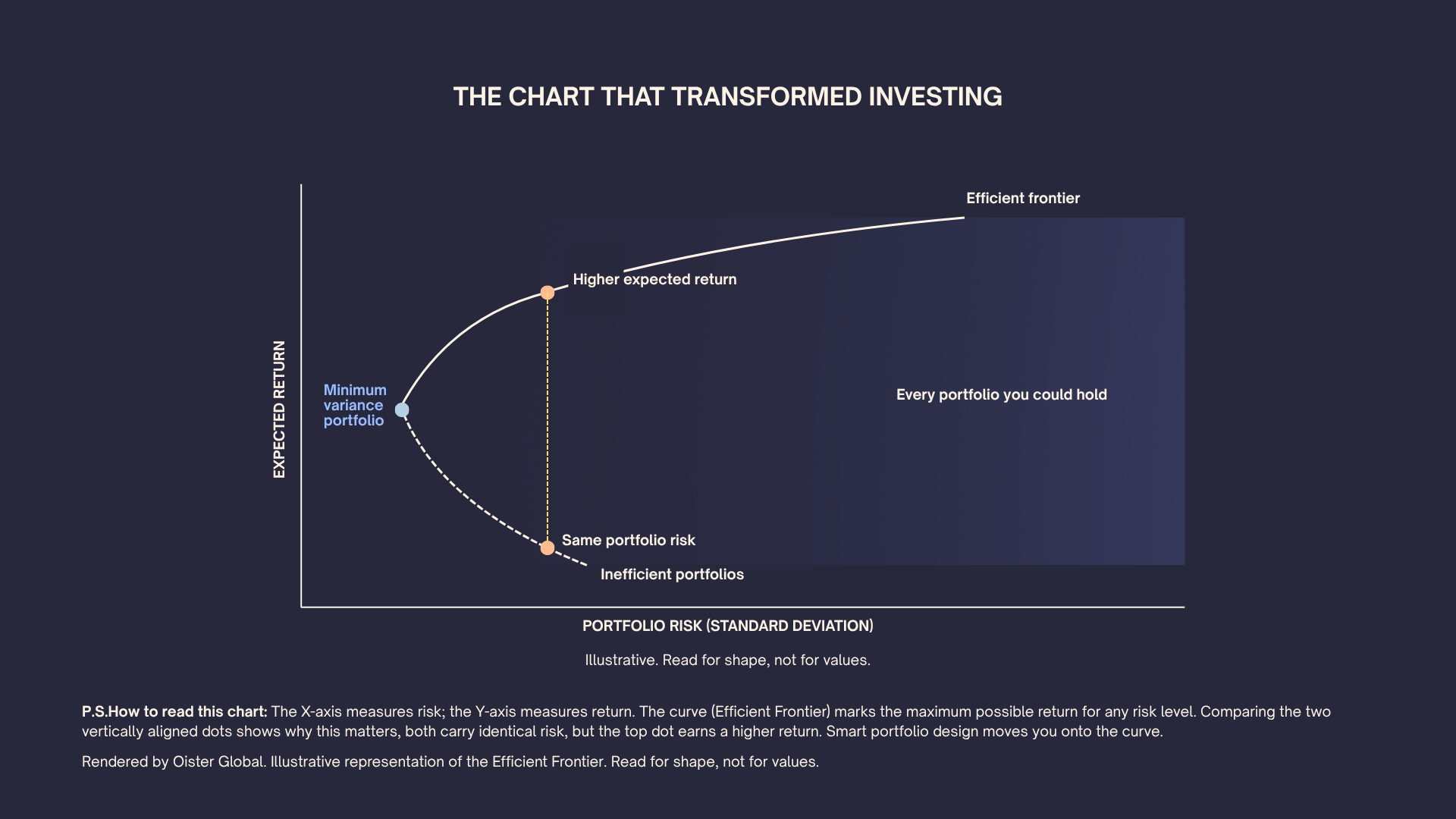
At first glance, the Efficient Frontier seems to reinforce the very idea we started with. Move further along the curve and expected returns rise. Higher risk. Higher return.
But that isn’t the breakthrough. Markowitz showed that risk and return are determined not just by the investments you own, but by how those investments interact inside a portfolio. The portfolio, rather than the individual investment, became the real unit of analysis.
That single insight transformed diversification. Until then, diversification was little more than common wisdom: don’t put all your eggs in one basket. Markowitz turned it into something that could be measured, tested and optimised. Investors no longer had to ask, “Which investment is the best?” They could instead ask, “Which combination of investments creates the best portfolio?” It was a subtle shift in thinking, but one that fundamentally changed modern investing.
Over the years, this way of thinking became the foundation of institutional investing. Pension funds, endowments, sovereign wealth funds and family offices around the world stopped thinking in terms of individual investments and started thinking in terms of portfolios.
But when Markowitz published Portfolio Selection in 1952, the investable universe was remarkably simple. Institutional portfolios were largely built using public equities and bonds. Today, the opportunity set looks very different.
Which raises an obvious question.
If the Efficient Frontier represents the best possible portfolio using the asset classes available at that time, what happens when entirely new asset classes enter the equation?
To answer that, we need to bring the conversation a little closer to home.
For most of us, the idea of a “portfolio” came with a familiar image. We built wealth through fixed deposits, PPF, gold and perhaps a second home. Equities, for many households, came much later. Mutual funds only entered the mainstream over the past two decades, fuelled by the rise of SIPs and a generation that began thinking differently about investing.
Institutional portfolios in India have followed a similar journey. They were largely confined to traditional asset classes, shaped by regulation, limited access and a relatively young private capital ecosystem. As that ecosystem has matured, so has the opportunity within it
India’s AIF industry is only about fifteen years old, growing with a CAGR of 30% over the past 5 years. Yet in that relatively short time, stronger fund managers have emerged, successful exits have built confidence, and access to private markets has expanded significantly. What was once considered a niche allocation is increasingly becoming a part of long-term portfolios.
Which brings us back to the question we left hanging.
If the Efficient Frontier changes when the opportunity set expands, what does it look like in a world where private markets become part of the portfolio?
If private markets are increasingly becoming part of the modern Indian portfolio, what does that actually mean for portfolio construction? Does adding an entirely new asset class simply expand the menu of investments, or can it fundamentally improve the portfolio itself?
To answer that, we turn to one of the most widely referenced frameworks in institutional investing, one that builds directly on Markowitz’s original idea.
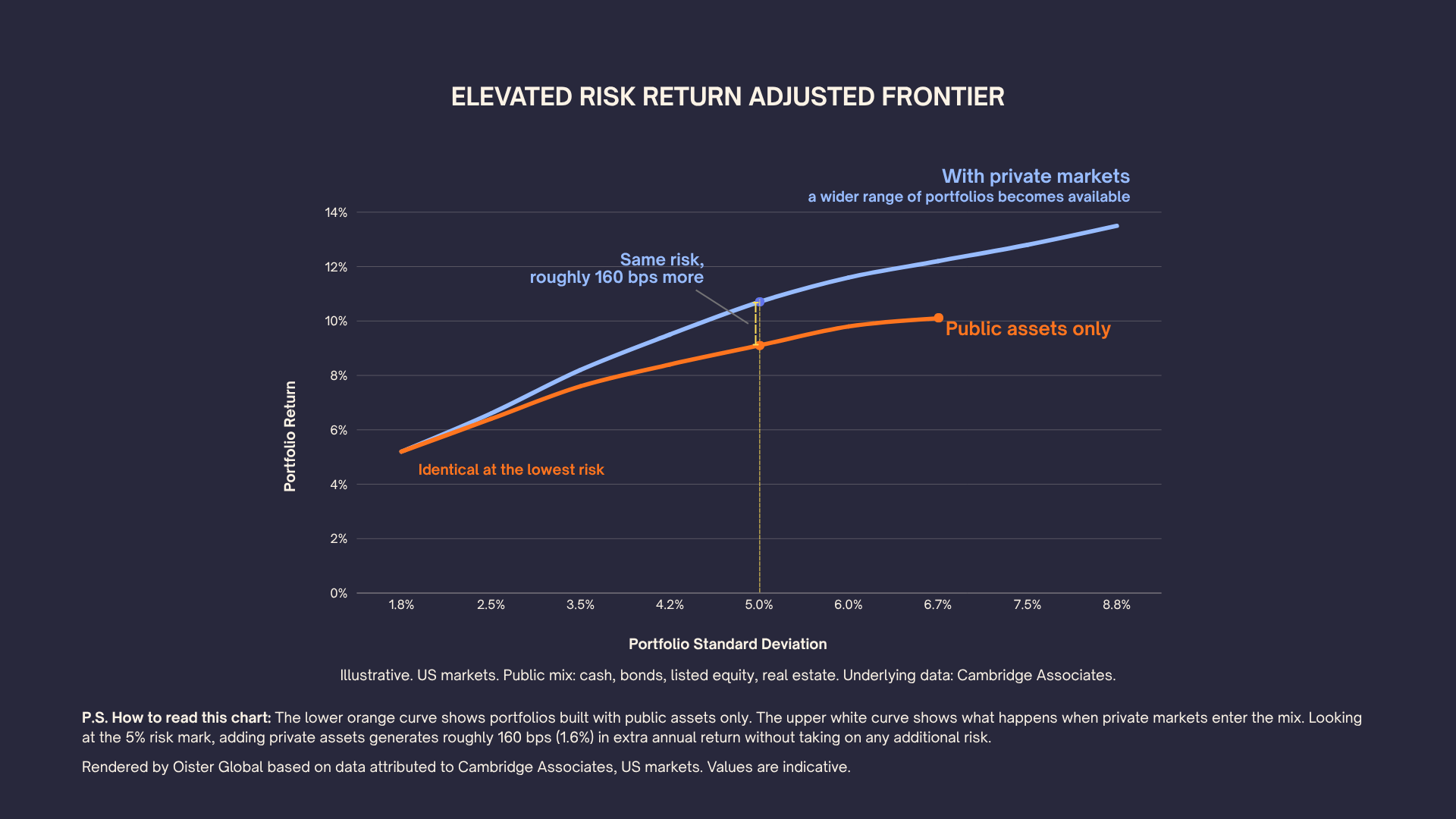
A study by Cambridge Associates ( A Classic) illustrates what happens when private markets enter the portfolio equation.
By now, this newsletter has probably started to feel a little more like a finance class than our usual editions. Bear with me for one more minute, because this is where Markowitz’s idea becomes tangible.
The chart answers a simple question: What happens when private markets become part of the portfolio?
The answer isn’t that returns magically increase, nor that portfolios simply become riskier. The opportunity set itself expands. By introducing an asset class that behaves differently from stocks and bonds, investors create more possible portfolio combinations. With more combinations comes a greater chance of building a portfolio that delivers the same expected return with less risk or a higher expected return without proportionately more risk.
The lighter curve doesn’t replace the darker one. It simply sits above it. In other words, the “best possible portfolio” changes because the building blocks have changed.
Perhaps that’s the most enduring lesson from Markowitz. The Efficient Frontier was never meant to be fixed. As the investable universe evolves, so too does the frontier. Theory, however, is only useful if it works in practice.
That brings us to one of the most influential institutional portfolios ever built.
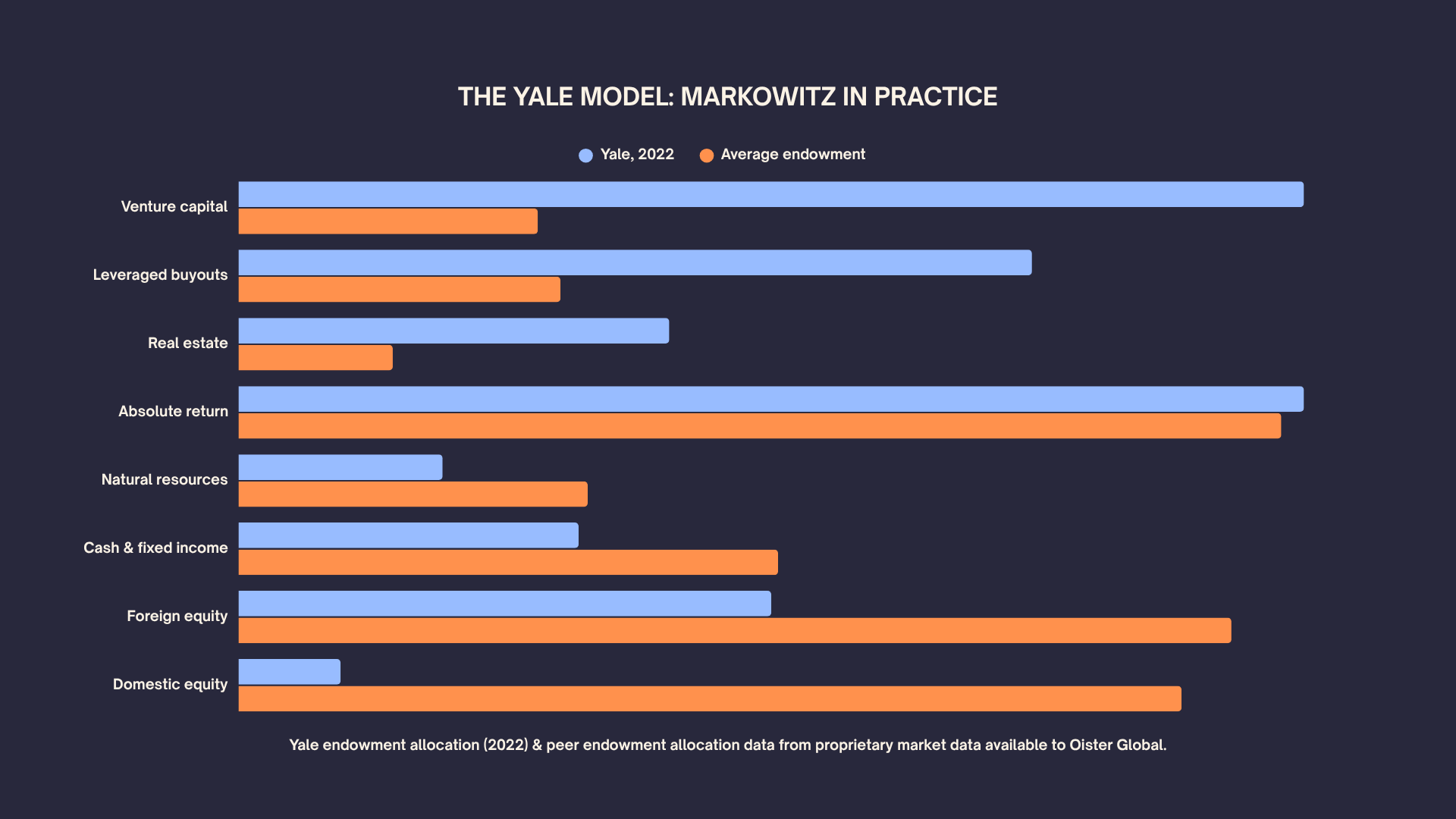
The contrast is striking. While the average endowment continued to allocate most of its capital to public equities and fixed income, Yale made private markets and alternatives the cornerstone of its portfolio. This wasn’t simply a different asset allocation—it was a different philosophy of portfolio construction.
More importantly, Yale showed that Markowitz’s ideas could extend well beyond theory. Its success transformed institutional investing, inspiring endowments, foundations, pension funds and family offices around the world to rethink how portfolios were built and to steadily increase allocations to private markets.
Over the past three decades, institutions around the world have gradually reimagined how portfolios are built. India is now entering a similar phase. Public markets have matured, private markets have deepened, and investors have access to an opportunity set that simply didn’t exist a decade ago.
That doesn’t automatically make portfolios better. It simply makes portfolio construction more important than ever. And perhaps that’s the biggest lesson we took away while researching this piece. Harry Markowitz’s most enduring contribution was a shift in perspective. He reminded us that the portfolio, not the individual investment, is ultimately the product.
That belief shapes how we think at Oister as well. When we study global institutions, benchmark fund managers, or spend time understanding how private markets are evolving, it isn’t because we’re trying to find the next exciting asset class. It’s because we believe better portfolios are built through better research, better product design and a deeper understanding of how different investments work together over the long term.
This edition of The Unlisted Intel was a little more technical than our usual ones, so thank you for staying with us. If you enjoyed this format, we’ll continue sharing some of the research, frameworks and ideas that shape how we think about private markets and portfolio construction.
Because in the end, investors don’t experience individual investments. They experience portfolios. And that’s the product we’re all trying to build better.
Jai Hind


TERMS OF USE
Thank you for your interest in our Website at https://unlistedintel.com/. Your use of this Website, including the content, materials and information available on or through this Website (together, the “Materials”), is governed by these Terms of Use (these “Terms”). By using this Website, you acknowledge that you have read and agree to these Terms.
NO OFFER, SOLICITATION OR ADVICE
Our site is provided for informational purposes only. It does not constitute to constitute (i) an offer, or solicitation of an offer, to
purchase or sell any security, other assets, or service, (ii) investment, legal, business, or tax advice, or an offer to provide such advice or (iii) a basis for making any investment decision.
The Materials are provided for informational purposes and have been prepared by Oister Global for informational purposes to acquaint existing and prospective underlying funds, entrepreneurs, and other company founders with Oister Global's recent and historical investment activities.
Please note that any investments or portfolio companies referenced in the Materials are illustrative and do not reflect the performance of any Oister Global fund as a whole. There is no obligation for Oister Global to update or alter any forward-looking statements, whether as a result of new information, future events, or otherwise.
PURPOSE LIMITATION AND ACCESS TO YOUR PERSONAL DATA:
We will only collect your personal data in a fair, lawful, and transparent manner. We will keep your personal data accurate and up to date. We will process your personal data in line with your legal rights. We use your name and contact details, such as email, postal address, and contact number to continue communications with you. We may also use your contact information to invite you to events we are hosting or to keep you updated with our news.
USE OF COOKIES OR SIMILAR DEVICES
We use cookies on our website. This helps us to provide you with a better experience when you browse our website and also allows us to make improvements to our site. You may be able to change the preferences on your browser or device to prevent or limit your device’s acceptance of cookies, but this may prevent you from taking advantage of some of our features.
MATERIAL
The material displayed on our site is provided “as is”, without any guarantees, conditions, or warranties as to its accuracy, completeness, or reliability. You should be aware that a significant portion of the Materials includes or consists of information that has been provided by third parties and has not been validated or verified by us. In connection with our investment activities, we often become subject to a variety of confidentiality obligations to funds, investors, portfolio companies, and other third parties. Any statements we make may be affected by those confidentiality obligations, with the result that we may be prohibited from making full disclosures.
MISCELLANEOUS
This Website is operated and controlled by Oister Global in India. We may change the content on our site at any time. If the need arises, we may suspend access to our site, or close it indefinitely. We are under no obligation to update any material on our site.
CONTACT INFORMATION
Any questions, concerns or complaints regarding these Terms should be sent to info@oisterglobal.com







 Learn More