



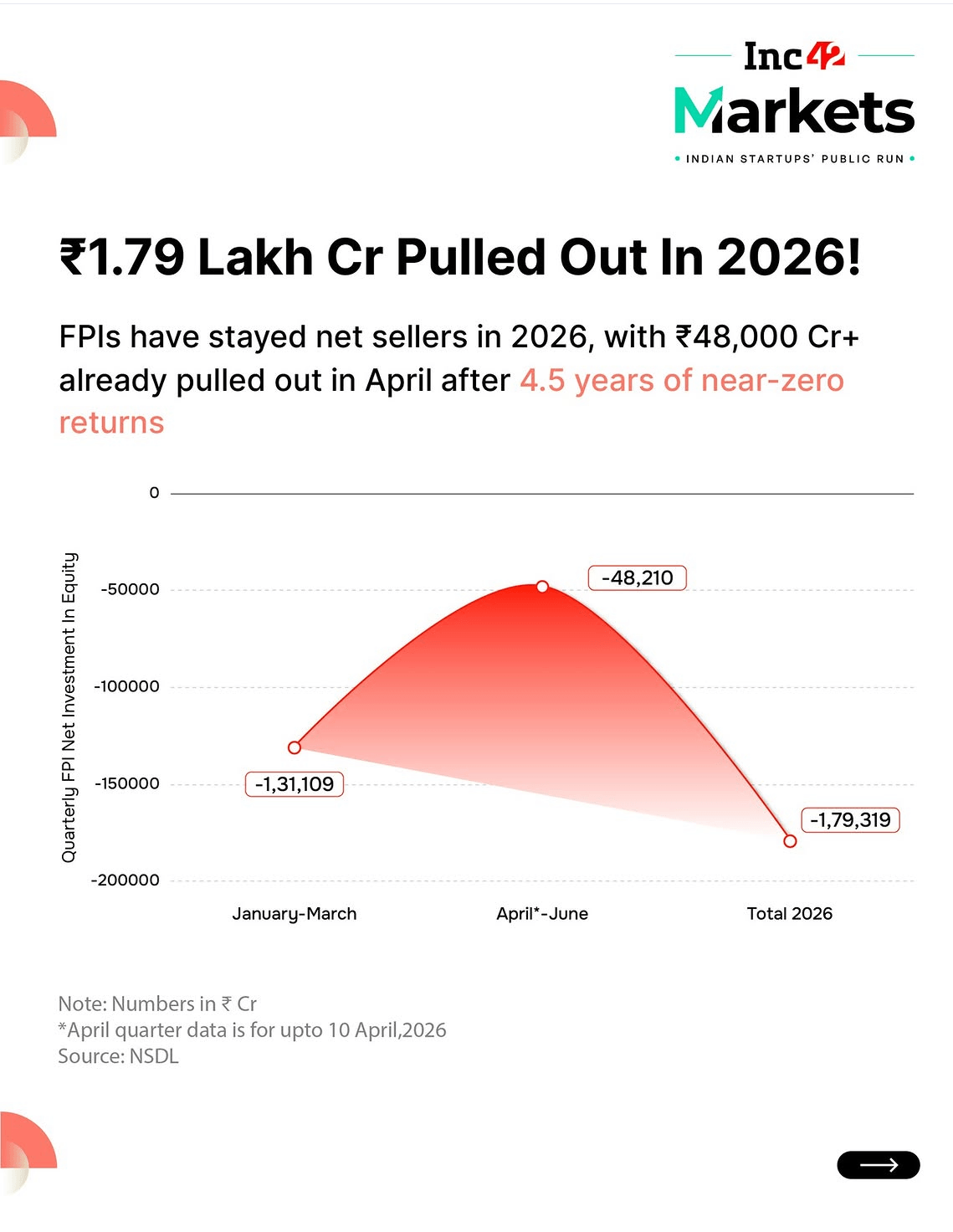
While India’s ~7% GDP growth confirms robust macroeconomic fundamentals, global institutional allocators are engineering a fundamental realignment away from public equity beta. High public market multiples relative to the broader MSCI Emerging Markets index, paired with currency headwinds near the 95.5 mark against the USD, have left public markets exposed to valuation overcrowding. Seeking manufactured, operationally driven alpha over volatile public ticker tapes, sophisticated Sovereign Wealth Funds (SWFs), pension funds, and family offices are anchoring their capital directly into unlisted private enterprises that lock in India’s secular domestic consumption engine.
Historically, the ultimate critique of the Indian private ecosystem was the “capital trap” dilemma—it was an easy market for capital deployment but a notoriously difficult one for extraction. In 2026, a systemic liquidity revolution overturned this paradigm as aggregate private market exits reached a historic $32.9 billion to $34 billion range. Strategic corporate M&A surged by over 210% year-on-year—headlined by Temasek’s $6.4 billion exit from Schneider Electric India—and was seamlessly complemented by a disciplined public window yielding 42 highly curated, PE-backed IPO listings. This functional feedback loop has proven to global investment committees that Indian private equity can deliver consistent, repeatable Distribution to Paid-In Capital (DPI).
| Sector | Private Capital Deployed | Core Institutional Catalysts |
|---|---|---|
| Infrastructure & Real Assets | $21.6 Billion (36% of total) | Supported by the state’s ₹12.2 lakh crore capex budget; clean-energy assets dominate, with renewables accounting for 48% of infrastructure deals. |
| Financial Services | $11.9 Billion (▲ 33% YoY) | Driven by deep credit financialization, robust bank balance sheets, and a monumental 391% surge in PIPE-structured block deals ($4.5B). |
| Consumer & Retail | Explosive Rebound (▲ 158% YoY) | Capitalizing on intense premiumization trends across an expanding affluent middle class; highlighted by the $1.6B Haldiram’s consolidation. |
| Manufacturing & Industrials | Strong Expansion (▲ ~55% YoY) | Catalyzed by global “China+1” supply chain realignments, the India Semiconductor Mission ($10B), and sovereign PLI schemes. |
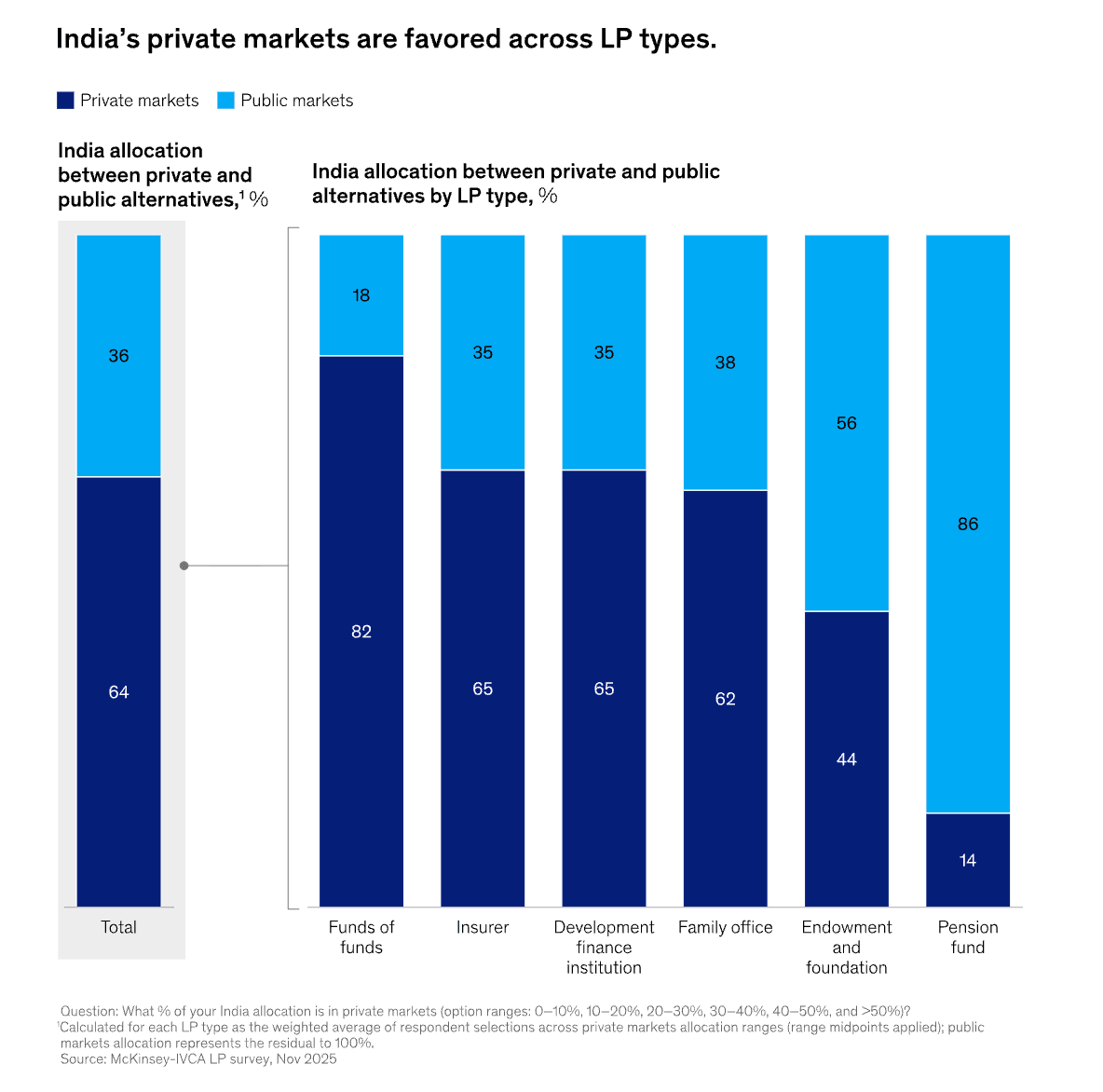
Source : Mckinsey & Company


TERMS OF USE
Thank you for your interest in our Website at https://unlistedintel.com/. Your use of this Website, including the content, materials and information available on or through this Website (together, the “Materials”), is governed by these Terms of Use (these “Terms”). By using this Website, you acknowledge that you have read and agree to these Terms.
NO OFFER, SOLICITATION OR ADVICE
Our site is provided for informational purposes only. It does not constitute to constitute (i) an offer, or solicitation of an offer, to
purchase or sell any security, other assets, or service, (ii) investment, legal, business, or tax advice, or an offer to provide such advice or (iii) a basis for making any investment decision.
The Materials are provided for informational purposes and have been prepared by Oister Global for informational purposes to acquaint existing and prospective underlying funds, entrepreneurs, and other company founders with Oister Global's recent and historical investment activities.
Please note that any investments or portfolio companies referenced in the Materials are illustrative and do not reflect the performance of any Oister Global fund as a whole. There is no obligation for Oister Global to update or alter any forward-looking statements, whether as a result of new information, future events, or otherwise.
PURPOSE LIMITATION AND ACCESS TO YOUR PERSONAL DATA:
We will only collect your personal data in a fair, lawful, and transparent manner. We will keep your personal data accurate and up to date. We will process your personal data in line with your legal rights. We use your name and contact details, such as email, postal address, and contact number to continue communications with you. We may also use your contact information to invite you to events we are hosting or to keep you updated with our news.
USE OF COOKIES OR SIMILAR DEVICES
We use cookies on our website. This helps us to provide you with a better experience when you browse our website and also allows us to make improvements to our site. You may be able to change the preferences on your browser or device to prevent or limit your device’s acceptance of cookies, but this may prevent you from taking advantage of some of our features.
MATERIAL
The material displayed on our site is provided “as is”, without any guarantees, conditions, or warranties as to its accuracy, completeness, or reliability. You should be aware that a significant portion of the Materials includes or consists of information that has been provided by third parties and has not been validated or verified by us. In connection with our investment activities, we often become subject to a variety of confidentiality obligations to funds, investors, portfolio companies, and other third parties. Any statements we make may be affected by those confidentiality obligations, with the result that we may be prohibited from making full disclosures.
MISCELLANEOUS
This Website is operated and controlled by Oister Global in India. We may change the content on our site at any time. If the need arises, we may suspend access to our site, or close it indefinitely. We are under no obligation to update any material on our site.
CONTACT INFORMATION
Any questions, concerns or complaints regarding these Terms should be sent to info@oisterglobal.com








 Learn More